Questions to ask before you hire a testimonial company
Twelve questions that separate a testimonial worth paying for from a pleasant video that sits on YouTube, with what a good answer sounds like and what we'd say
 6 min read
Before hiring a testimonial company, ask who runs the interview and whether they know your market, who invites and schedules your customer, whether answers are scripted, how the recording happens, what arrives and how quickly, who approves it, what you're allowed to do with it, what happens if you're not happy, and whether every quote is exactly what your customer said. The answers matter more than the sample reel.
A sample reel tells you a company can make a nice-looking film. It doesn't tell you whether they'll get a real story out of your customer, whether your team will ever use what arrives, or what happens when your customer's lawyer wants a line removed. Those are the things that decide whether the money was well spent, and they come out in a fifteen-minute conversation if you ask the right questions.
Here are the twelve I'd ask, why each one matters, and what a good answer sounds like. I've put our own answer under each, so you've got something to compare against.
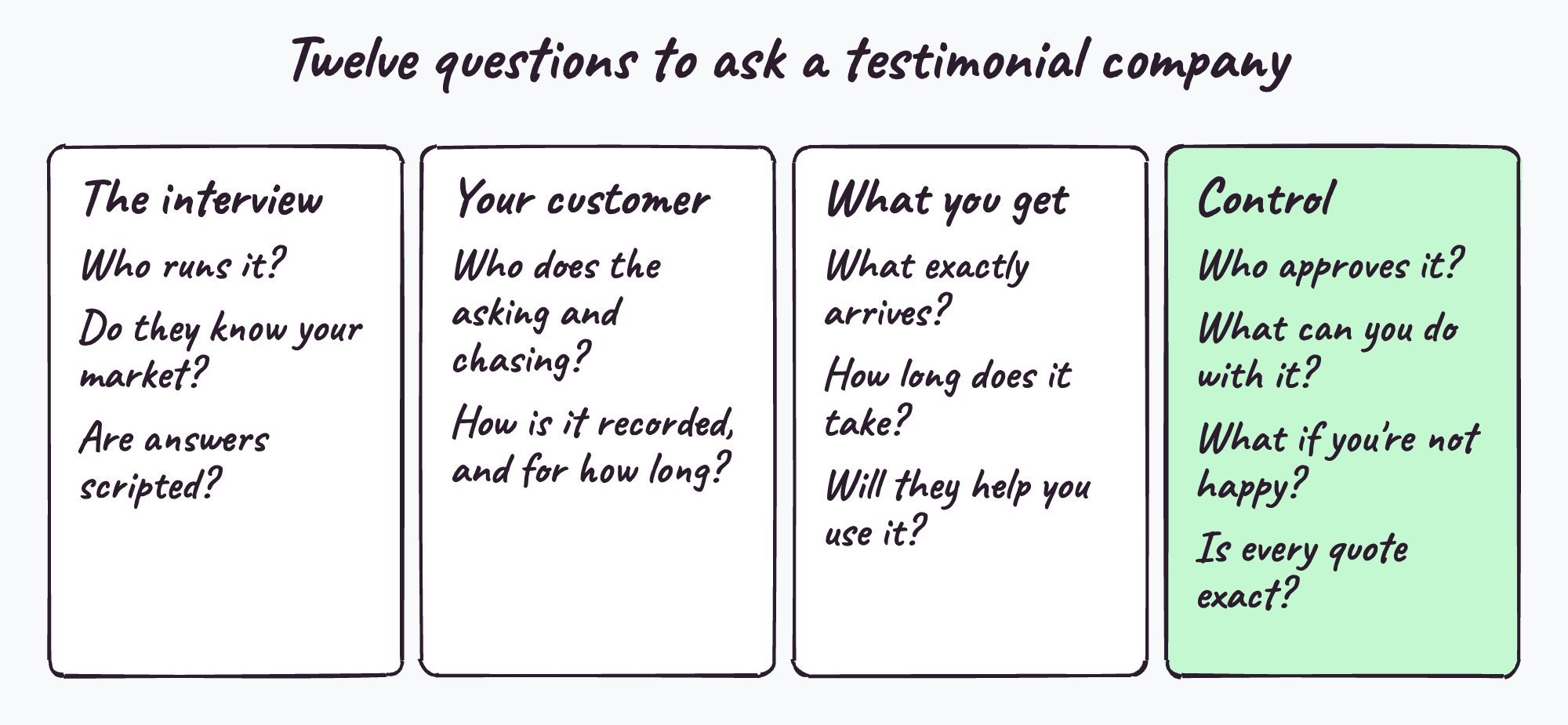
About the interview
1. Who actually runs the interview?
Why it matters: the interview decides whether you get a story or a set of polite compliments. A named, experienced interviewer who follows up on the interesting moment is worth far more than a producer working through a list, or a set of prompts on a screen.
A good answer names the person and tells you how they prepare.
Ours: James runs the interviews, having researched your customer's company and yours first. He also writes the questions, chooses the moments afterwards and writes the edit notes; a human editor cuts the film and people review it before you see it. None of it is automated.
2. Do they know your market?
Why it matters: if your customer has to spend ten minutes explaining what an MSP does or why a migration mattered, that's ten minutes of story you don't get.
Ours: we work only with MSPs, IT service companies and the vendors who sell through them.
3. Are the answers scripted?
Why it matters: scripted answers sound scripted, and buyers discount them. You want a conversation, not a reading.
A good answer: your customer knows the topics, or sees the questions if they'd like to, and nothing is memorised.
Ours: nothing to prepare and nothing to memorise. We share what we'll cover in advance if your customer wants to see it.
About your customer's experience
4. Who asks your customer, schedules them and chases them?
Why it matters: this is the bit that stalls most testimonials, and it's easy to be quoted a price that quietly leaves it with you.
Ours: you make a short introduction; we do the asking, the scheduling and the chasing.
5. How is it recorded, and how much of your customer's time does it take?
Why it matters: a crew in your customer's office is a big ask. A long, awkward session is worse.
Ours: always remote. A 45-minute conversation on your customer's own phone through the Riverside app, with a small tripod we post to them beforehand.
About what you get
6. What exactly arrives, and in what formats?
Why it matters: some services deliver one film. Others deliver the film plus the written case study, sales material and posts. Compare like with like.
Ours: 48 pieces from one interview, including a full film, a teaser, five shorts, a sales battlecard, a case study, a one-page sales guide, social posts, emails and a blog post. There's the full list in what you get from one testimonial interview.
7. How long does it take?
Why it matters: a story that arrives three months after the interview has lost its moment, and so has your team's enthusiasm.
A good answer tells you when the clock starts as well as how long it runs.
Ours: the full pack arrives 14 working days after the interview. Approvals follow at your pace and your customer's.
8. Will they help you use it?
Why it matters: most testimonials fail because nobody decides where they go, not because they're badly made.
Ours: every pack has a short Start Here guide saying what to do first, a walkthrough video, and placement decided for your own website pages.
About control and ownership
9. Who approves it before anything is published?
Why it matters: your customer needs to be comfortable, and so do you.
Ours: you approve it first, then your customer approves their own story. Nothing goes live until both of you have signed it off.
10. What can you do with it, and for how long?
Why it matters: you don't want to discover later that you can't use a film in a paid ad or after a year.
Ours: a perpetual licence to use every delivered piece in your own marketing. We may show the work in our own portfolio unless you tell us in writing not to. There's more on this in who owns a testimonial, and what happens if the customer leaves?
11. What happens if you're not happy?
Why it matters: a guarantee tells you how confident a company is in its process, and the small print tells you what it covers.
Ours: if we can't get it to a standard you're proud to publish, you get a full refund for that story. The terms set out the exceptions, such as a change of mind after delivery or a customer withdrawing after the interview.
12. Is every quote exactly what your customer said?
Why it matters: quotes stitched together from different parts of an interview, or numbers rounded up in a headline, put words in your customer's mouth. It's the fastest way to lose a customer's goodwill and a buyer's trust.
Ours: every quote is taken word for word from the recording and checked against the transcript before anything ships, and every number in a headline has to be something your customer actually said.
Red flags worth noticing
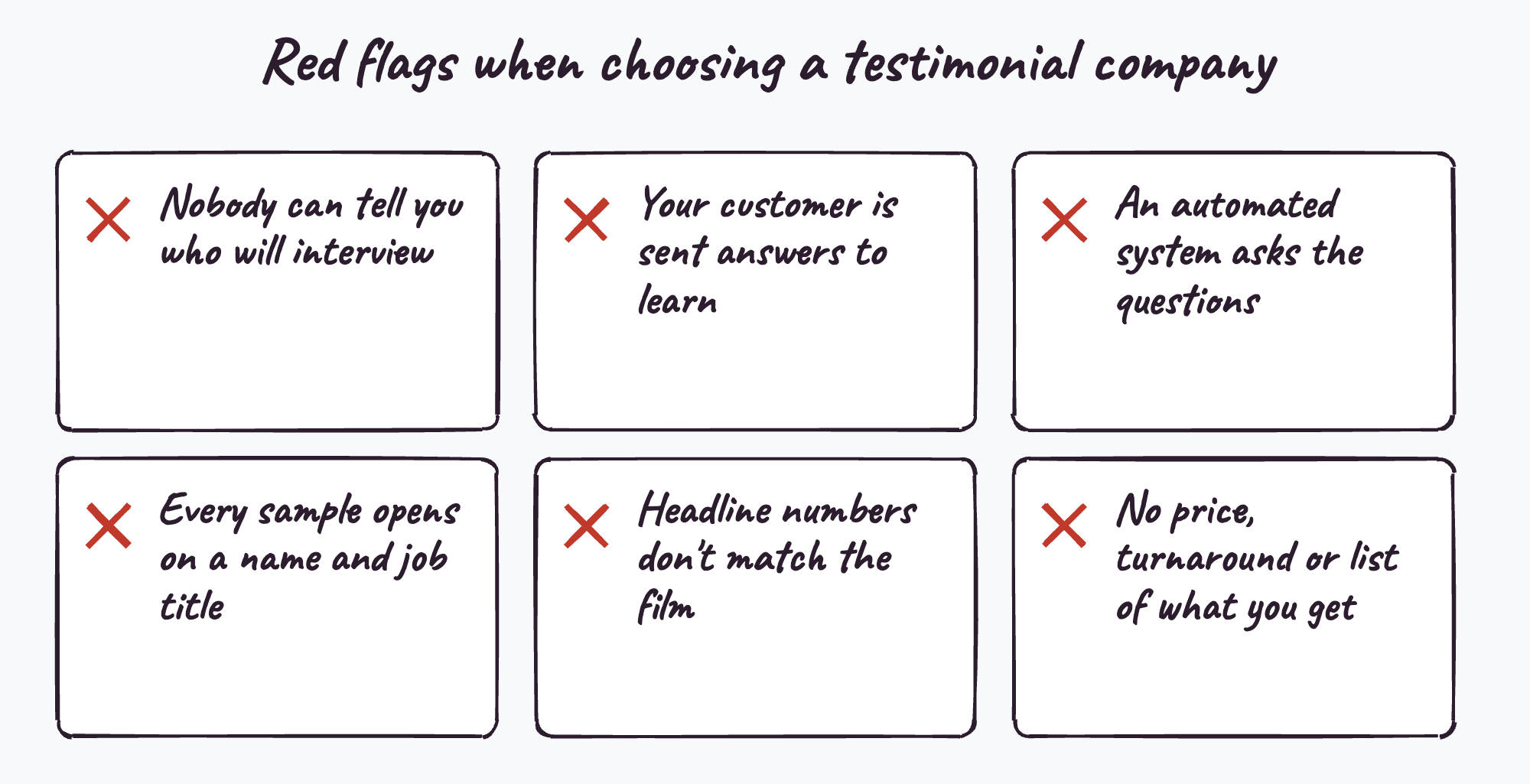
- Nobody can tell you who will interview your customer.
- Your customer is sent answers to learn, or told what to say.
- An automated system asks the questions, with nobody listening to follow up.
- Sample films all open with a name and job title and contain no real moment.
- Headline numbers don't match what the customer says in the film.
- No published price, turnaround or list of what you get, so every conversation starts from scratch.
None of these on its own means a company is bad. Two or three together usually means the interview is an afterthought, and the interview is the part that decides whether the film is worth anything.
Questions people ask
What should I look for in a video testimonial company?
A named interviewer who knows your market, a clear process for inviting and scheduling your customer, a list of exactly what you'll receive and when, approval for you and your customer, a clear licence, a guarantee, and a firm policy that every quote is word for word.
Should a testimonial company write the questions?
Yes, and they should research your customer first. Good questions are tailored to the story, and the best material comes from follow-up questions an experienced interviewer asks in the moment.
Is it better to hire a testimonial company or do it yourself?
Doing it yourself costs less and works if you have a confident customer and someone who can interview and edit. A specialist earns its fee on the interview, the asking and scheduling, and everything built from the recording.
Related reading
- What makes a good video testimonial?
- How much does a video testimonial cost?
- The best way to get video testimonials made
Ask us all twelve. We'd rather you compared us properly than bought on a sample reel.
Book a quick callJames interviews MSP and tech vendor customers for a living and runs MSP Testimonials, the interview-led testimonial service. If a customer of yours has a story worth telling, this is how it gets told.