Five quick wins for the testimonials already on your MSP website
Before you commission anything new, spend a week on the quotes, reviews and kind emails you already own. Most of them are doing far less than they could
 8 min read
Most MSPs can improve the testimonials on their website in a week without commissioning anything new. Gather every quote, review and kind email you already own into one list, check each one is still true and date it, put the customer's full name, role and company back on it, move it to the page where that decision gets made, and make sure it is real text that people and search engines can read. Doing those five in order also shows you exactly which stories you are missing.
Every MSP website I look at has proof on it somewhere, and almost none of it is working as hard as it could. A quote from a finance director sits on the About page with the name taken off, a Google review from a solicitor has never been replied to, and the best thing a customer ever wrote is in an email from 2023 that only the account manager has read. The instinct when a website feels thin is to go and get something new, which is sometimes right, but it is the expensive answer and rarely the first one.
So here are five things you can do this week with what you already own, in the order a sensible person would do them, because each one makes the next easier and the last hands you a list of what to get next.
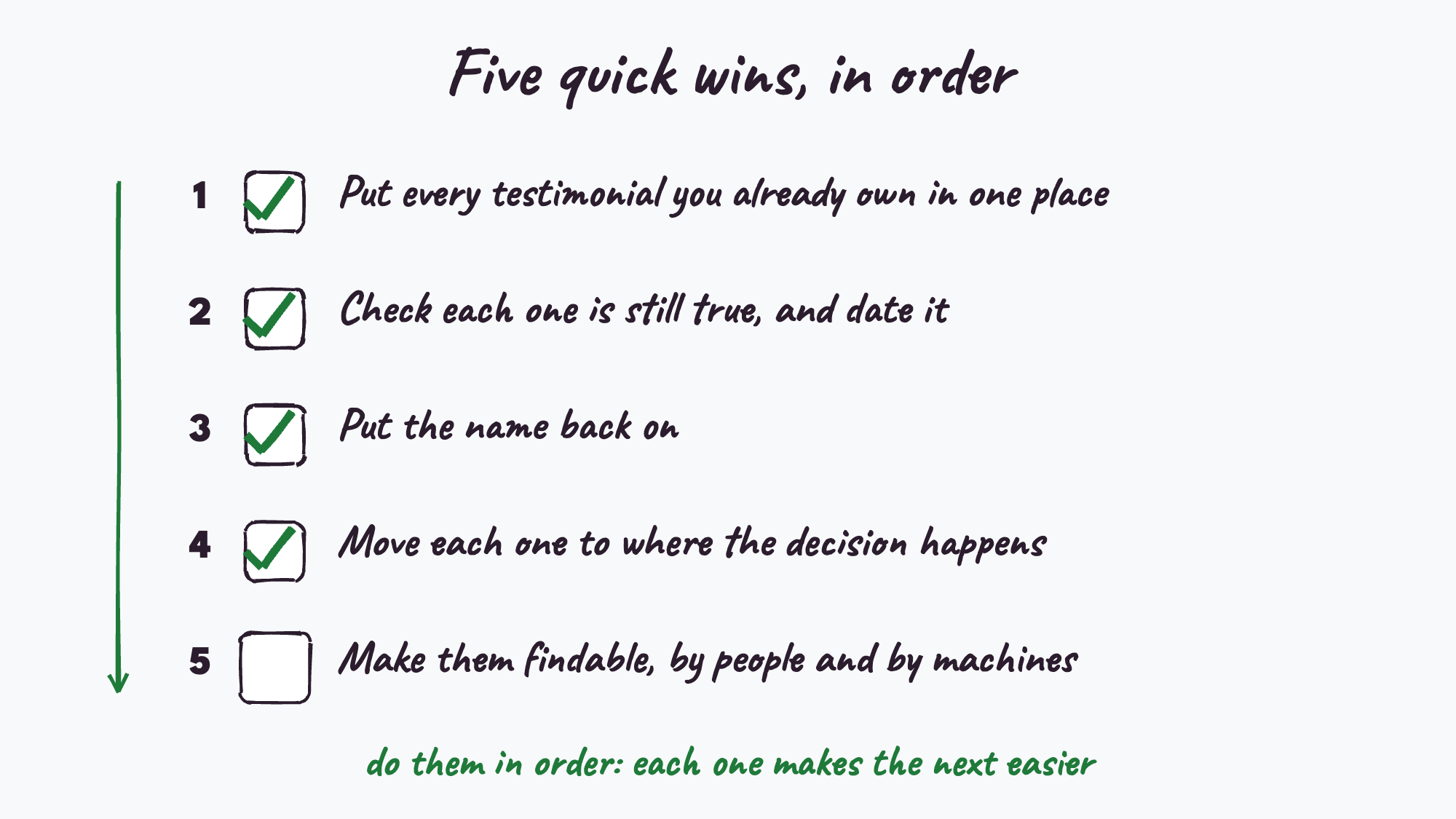
1. Put every testimonial you already own in one place
You almost certainly have more than you think, because nobody has ever counted. Start a spreadsheet (a spreadsheet is fine, honestly) and look in every place a customer might have said something good about you:
- Your own website, including the About page, the footer and old landing pages
- Google reviews
- CSAT and ticket-close comments from your helpdesk
- Emails your engineers and account managers have been sitting on
- Proposals and tender responses, which often carry a reference quote nobody else has seen
- LinkedIn recommendations for you and your team
- Any case study or video you have ever had made, published or not
For each one, record the same things: the exact words, the person's full name, role and company, the date, the service they were talking about, and where on your site or in your sales material it is currently used, if anywhere.
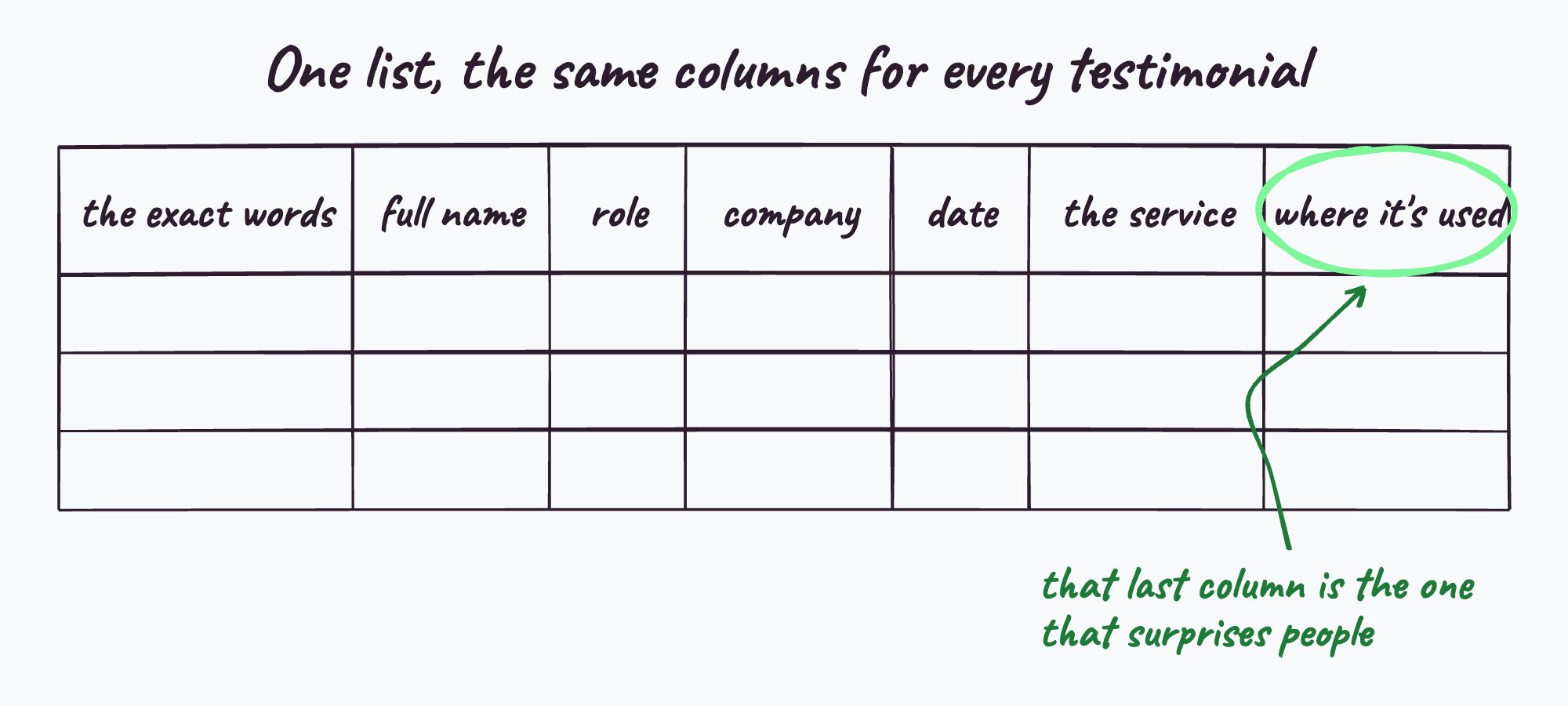
That last column is the one that surprises people, because for most rows the answer is "nowhere", and the ones that are used tend to be the same three, repeated on every page. The list is the only way to see the whole picture at once, which is why it comes first.
2. Check each one is still true, and date it
A testimonial goes stale for specific reasons, and none of them is age on its own: the person may have left, the company may no longer be a client, the service they praised may have been replaced, or a number in it may have quietly stopped being true. The yearly check is written up in how long does a testimonial stay useful?, and its four questions take about a minute per row once the list exists.
The point of doing it now, before you move anything, is that you do not want to give the prime spot on your cyber security page to a customer who left you in March. The US Federal Trade Commission's Endorsement Guides say an advertiser may keep running an endorsement only while it has good reason to believe the endorser remains a genuine user, which is American guidance, but as a yardstick it is hard to argue with. Where a quote fails, retire it or ask the customer to refresh it; where it passes, add the date to the list and to the page.
3. Put the name back on
An unattributed quote is decoration. "They've been brilliant, we'd never go anywhere else" with nothing underneath reads exactly like something the marketing team wrote, and a buyer who has read a dozen MSP websites that week will treat it that way. The fix costs nothing: full name, role, company, a date, and a photo or logo where the customer has agreed to it.
The pattern I see most is the first of the six ways MSP websites hide the proof they already have: a customer named in full on the homepage and reduced to "a client in professional services" on the service page, which is exactly where the proof needed to be strongest. If a customer has agreed to be named anywhere, ask whether they are happy to be named everywhere that story appears, and most say yes, because a quote with their name on it is a compliment to them as well. What you are trying to avoid is anonymity by accident, where nobody asked and the name fell off because the template only had room for a quote.
4. Move each one to where the decision happens
This is the win that changes results, and the one most MSPs skip because the testimonials page feels tidy. A buyer on your Microsoft 365 page is asking whether you are any good at Microsoft 365 for a business like theirs, and a general quote about your friendly helpdesk does not answer that. A customer who bought that service, describing what changed, does.
Go back to the list and use the service column. Match each quote to the page for the service the customer actually bought, using your own website navigation as the list of pages, and give each page one chosen quote rather than a slider of the same three. Then fill the other places a decision gets made:
- The contact page, next to the form, with your longest verdict quote, because that is the highest-intent moment on your site
- The pricing page, with a quote that answers the objection that stalls most of your deals
- The proposal template, chosen by the prospect's sector rather than by service
- Your email signatures, with a short line and a name, the most frequently seen proof you have
There is a full room-by-room list in where to put testimonials on your MSP website, and the rule underneath all of it is to match the proof to the question the page is answering. Keep the testimonials page as an archive if you like, but your best quote should not be living there at the expense of the service page where it would have changed someone's mind.
5. Make them findable, by people and by machines
The last win is about format, which is where good intentions most often go wrong.
Put the quote on the page as real text, never as an image of text. A quote card exported from a design tool looks nice and reads as nothing to a search engine or an AI tool, and the W3C's accessibility guidelines ask for text rather than images of text so that people who need to resize it can. Use the card on social, and put the words on the page as text.
Reply to your Google reviews. Google's own guidance for Business Profiles says that when you reply to reviews you show customers you value their feedback, and an unanswered run of five-star reviews looks, to a prospect scrolling through them, like a business that stopped paying attention. Two sentences each, naming what they praised, is enough.
Be honest about review schema. Marking up a story page does no harm, but Google's review snippet guidelines say reviews a business hosts about itself are not eligible for star ratings, and that any review you mark up has to be visible on the page anyway. Anyone promising you stars from your own testimonials is selling something; what matters is the words being on the page where a person and a crawler can both read them.
Give the substantial ones a page of their own. Where a testimonial has a real before and after, a named service and a result, give it a dated page with the customer's name in the title, the full text and any film embedded above it. That page is what you link to from the service page and the proposal, and the version a search engine can index.
What the five will show you
Do them in order and, somewhere around the fourth, the list stops being a tidy-up and becomes a diagnosis. You will find a service page with no customer on it, a sector you want to win with nobody from that sector on record, and probably that nothing you own is on video, or that the one film you have is four years old and mentions a product you have since replaced.
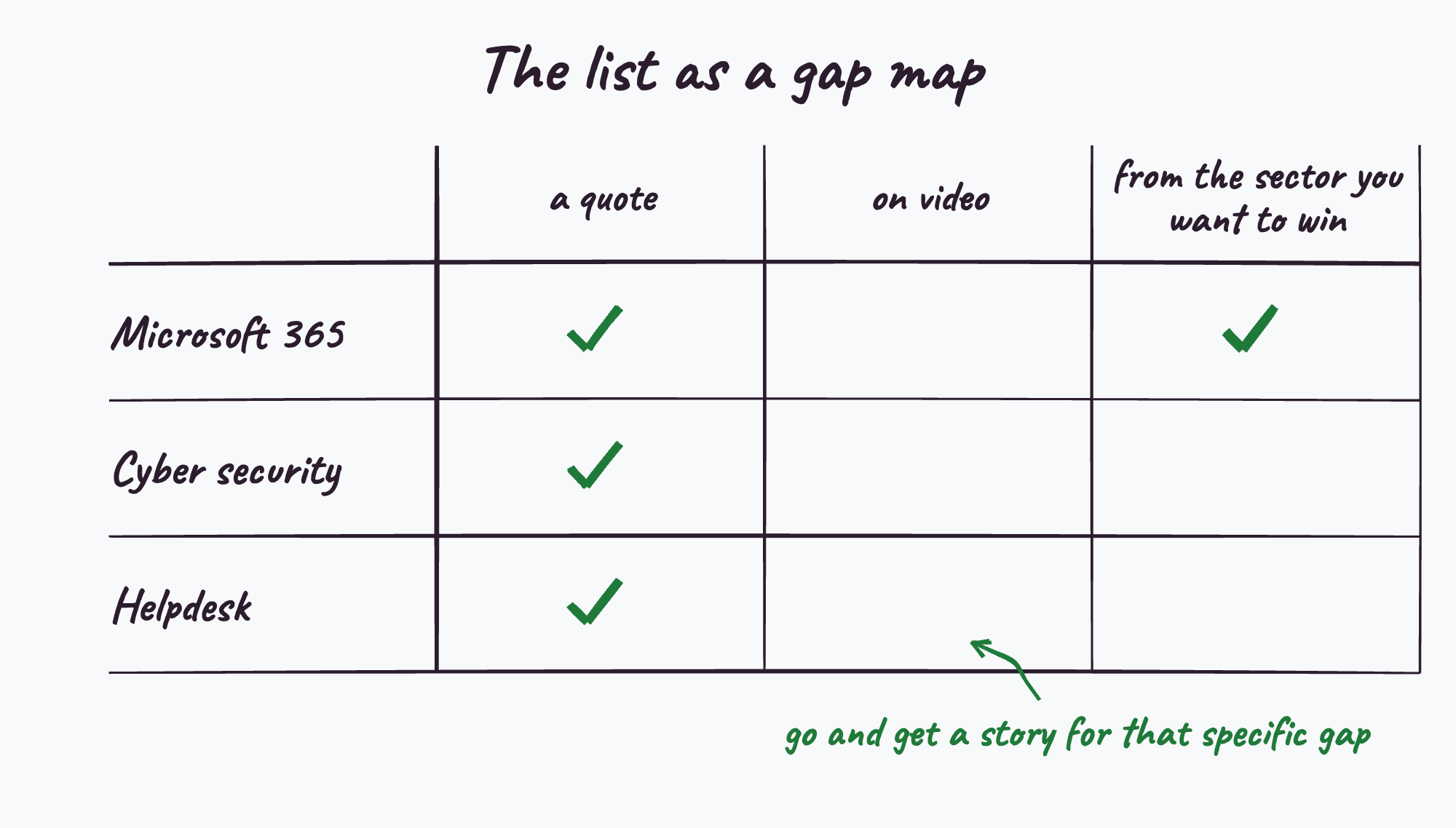
That is a different kind of problem from the one you started with. The first four wins are about deployment, putting what you have where it works, and they cost you a week. The gaps are a supply problem, and no amount of re-polishing the quotes you already own will fill a lane that has no customer in it. The fix is to go and get a story for that specific gap, chosen for the page it will sit on. There is a way to work out how many you need in how many testimonials does your business need? and a way to pick the right customer for each in which client should you ask for a testimonial?
When this isn't the right week for it
If you have two quotes and a Google rating, the list takes ten minutes and the honest conclusion is that you need some stories before there is anything to arrange. If you are mid-rebrand, gather and check now, because that work survives any redesign, and leave the placement until the new pages exist. Otherwise this applies to almost every MSP I have looked at, including, for a while, our own site.
Questions people ask
How do I collect the testimonials I already have?
Search your website, Google reviews, helpdesk CSAT comments, emails, proposals and LinkedIn recommendations. Put each one in a spreadsheet with the exact words, the person's name, role and company, the date, the service and where it is used.
Should testimonials be text or images on a website?
Text. An image of a quote cannot be read by search engines, AI tools or screen readers. Use the image on social and put the same words on the page as text.
Do I need review schema on my testimonials?
It does no harm, but do not expect star ratings from it. Google does not show review stars for reviews a business hosts about itself, and any marked-up review has to be visible on the page anyway.
Related reading
- Where to put testimonials on your MSP website
- Six ways MSP websites hide the proof they already have
- How long does a testimonial stay useful?
- CSAT vs NPS for MSPs and tech vendors
The five wins take a week and show you the gaps. Filling a gap with a real customer, on film and in writing, chosen for the page it will sit on, is the part we do.
See how it worksJames interviews MSP and tech vendor customers for a living and runs MSP Testimonials, the interview-led testimonial service. If a customer of yours has a story worth telling, this is how it gets told.