Who owns a testimonial, and what happens if the customer leaves?
Permission, licences, job changes and customers who move on. The practical side of using customer testimonials, with what the rules say and what we do
 5 min read
Who owns a testimonial depends on what was agreed. Typically the business that commissioned it gets the right to use it in its marketing, while the customer keeps their name, image and brand and approves what's published. Get that permission in writing, record which uses were agreed, date every story, and update or retire a testimonial when the person changes job, the customer leaves, or what they said is no longer accurate.
Nobody thinks about this until it happens: the finance director in your best testimonial moves to a competitor, or a client you featured on your homepage gives notice. Suddenly the question of who owns the film, and whether you can keep using it, becomes very practical.
I'm not a lawyer, and nothing here is legal advice, so check anything specific with your own adviser. But the practical side is mostly common sense, and it's much easier to get right at the start than to untangle later.
Who owns a testimonial?
It depends on what was agreed, and there are usually several layers.
- The customer keeps their own name, face, voice, company name and logo. They're allowing you to use them in a particular way.
- The business that commissioned it gets the right to use the finished testimonial in its marketing, on whatever terms were agreed.
- The company that produced it may keep some rights too, such as showing it in their own portfolio.
How it works with us: on payment you receive a perpetual licence to use every delivered piece in your own marketing. We may reference the work in our own portfolio and marketing unless you tell us in writing that you'd rather we didn't. Your customer approves their own story before anything is published. It's all in our terms.
What permission should you get?
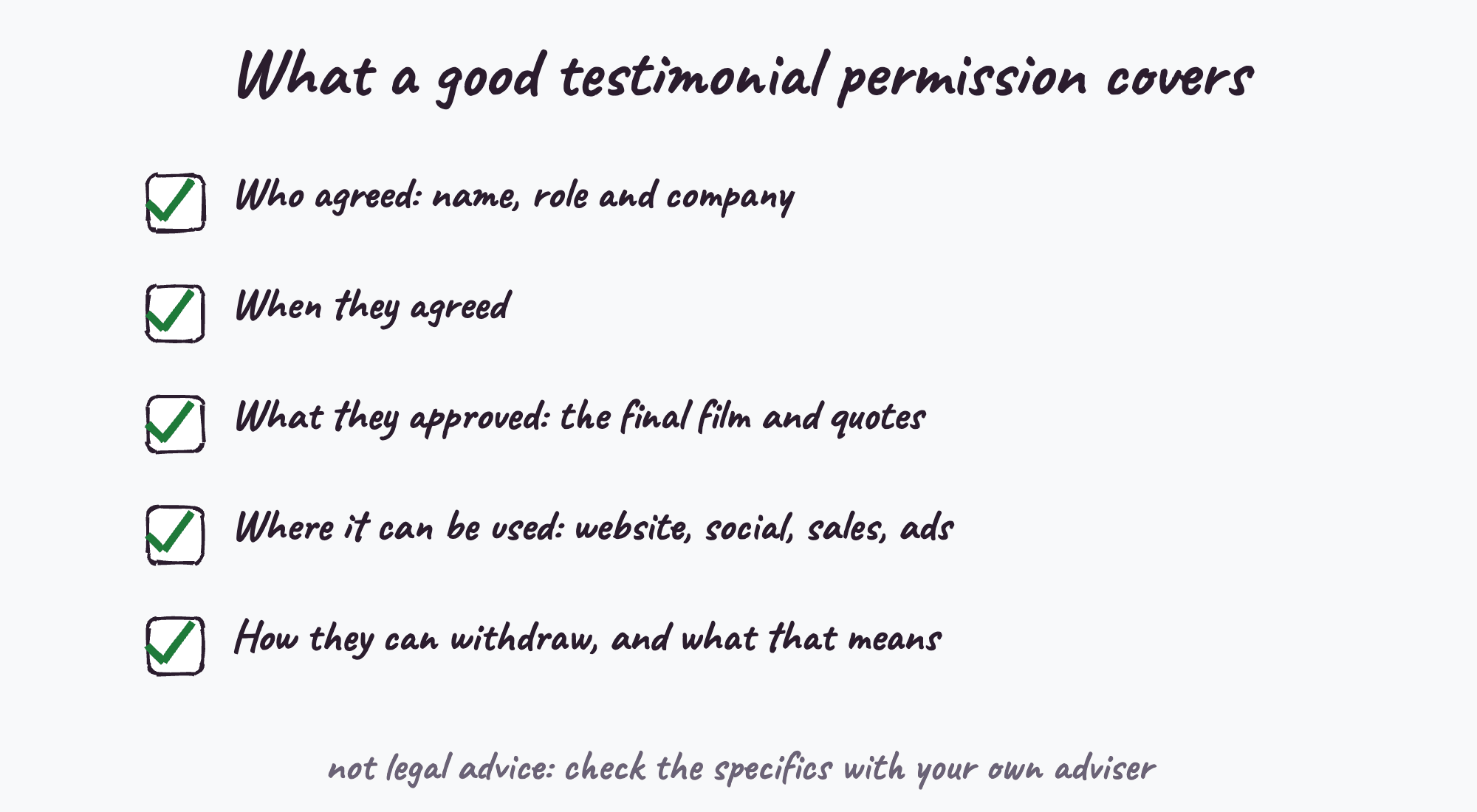
Get it in writing, and make it specific. The useful things to record are:
- Who agreed, with their name, role and company.
- When they agreed.
- What they approved: the final film and quotes, as well as the idea.
- Where it can be used, such as your website, social media, sales material, paid adverts or events.
- How they can withdraw, and what that means in practice.
In the UK, if you're relying on consent, the Information Commissioner's Office expects you to keep records showing who consented, when, what they were told and whether they've withdrawn, and says withdrawing should be as easy as giving consent. Consent isn't the only lawful basis for using someone's information, which is exactly the sort of question to take to an adviser.
What if the person changes job?
This is the most common one. Your testimonial features "Sarah Jones, Operations Director, Example Ltd", and Sarah has moved on.
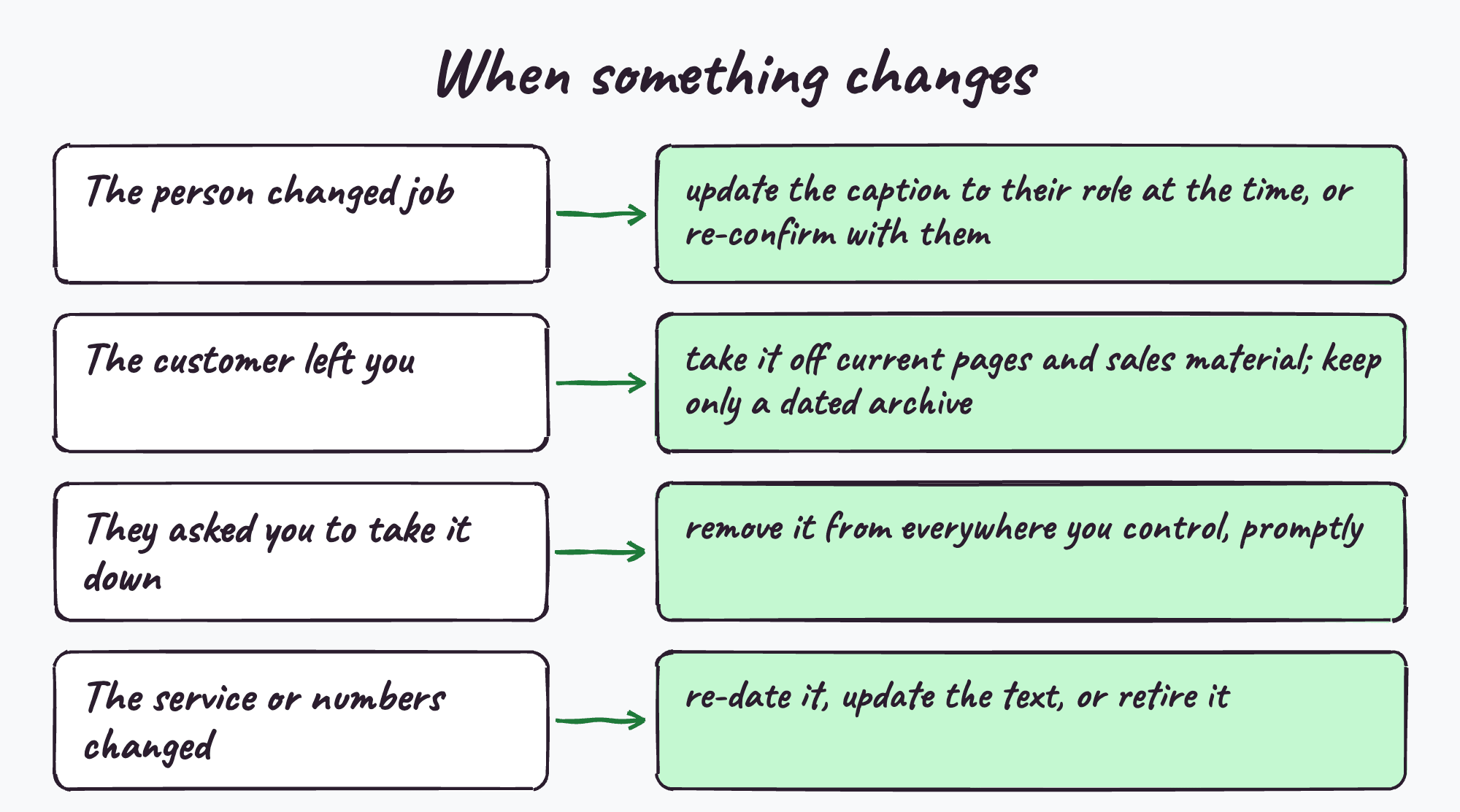
The story itself is still true: it happened, she said it, and the company is still your customer. What's out of date is the caption. The sensible options are to update the page to say she was operations director at the time, re-confirm with her that she's happy for it to keep running, or, if the company would rather feature a current person, retire it from the front of your website and keep it in a dated archive.
What you shouldn't do is keep presenting her as a current employee endorsing you, particularly in sales material where a prospect might pick up the phone to her old office.
What if the customer stops being a customer?
Then the testimonial stops being a current endorsement, and it shouldn't be presented as one. A story from a former client on your homepage implies they're still happy with you today, and a prospect who checks will find otherwise.
The guidance from the US Federal Trade Commission is a useful yardstick even if you're not in the US. Its Endorsement Guides say an advertiser can keep running an endorsement only while it has good reason to believe the endorser remains a genuine user of the product, while a clearly dated historic post doesn't need deleting. Re-sharing old material is a different matter from leaving a dated post in place.
In practice: take it off your current pages and out of your sales material, and if you keep it anywhere, keep it clearly dated.
What if the customer asks you to take it down?
Take it down, promptly, from everywhere you control. It's their name and their face, and goodwill with a former champion is worth more than one testimonial. Be honest that you can remove it from your own website, channels and materials, but can't always recall copies other people have already shared.
What if the product or service has changed?
If a testimonial praises something you no longer offer, or describes a process that's since changed, it can mislead a buyer. Re-date it, update the surrounding text, or retire it. The same goes for a number in the story that's no longer true.
What about team testimonials?
The same principles apply to your own staff in recruitment videos, with one more thing to plan for: people leave. Agree up front what happens to their video when they do. I've covered team videos in should your MSP make team testimonials?
Questions people ask
Who owns a video testimonial?
It depends on the agreement. Usually the business that commissioned it has the right to use it in its marketing, the customer keeps their own name, image and brand, and the producer may keep portfolio rights. With us, you receive a perpetual licence to use every delivered piece in your own marketing.
Do you need written permission to use a customer testimonial?
It's strongly advisable. Record who agreed, when, what they approved and where it can be used, and make it easy for them to withdraw. Check the specifics with your own adviser.
Can you keep using a testimonial after the customer leaves?
Not as a current endorsement. Remove it from current pages and sales material, and keep it only in a clearly dated archive if you keep it at all.
What should you do if someone in a testimonial changes job?
Update the caption to show their role at the time, re-confirm with them, or retire the testimonial if the customer would prefer to feature someone current.
Related reading
- How long does a testimonial stay useful?
- Questions to ask before you hire a testimonial company
- How a remote video testimonial works
Every story we make is approved by you and then by your customer, with a perpetual licence for your own marketing.
See how it worksJames interviews MSP and tech vendor customers for a living and runs MSP Testimonials, the interview-led testimonial service. If a customer of yours has a story worth telling, this is how it gets told.