What makes a good video testimonial?
A checklist for judging any testimonial film, including the sample reel of whoever is trying to sell you one
 6 min read
A good video testimonial opens on a real moment rather than a name and job title, features a customer your buyer recognises as a peer, describes a specific before and after, and keeps every sentence exactly as the customer said it. It is short enough to finish, easy to follow with the sound off, shows the person's name, role and company on screen, and ends with a clear verdict a buyer could act on.
Almost every testimonial company will show you a sample reel, and almost every sample reel looks good. Nice lighting, a friendly face, pleasant music. Looking good is the easy bit now, because production is buyable. What separates a film that wins deals from one that gets a polite thumbs up is almost entirely underneath the production.
So here's the checklist I use, both on our own films and when I watch anyone else's. You can use it on the next sample somebody sends you.
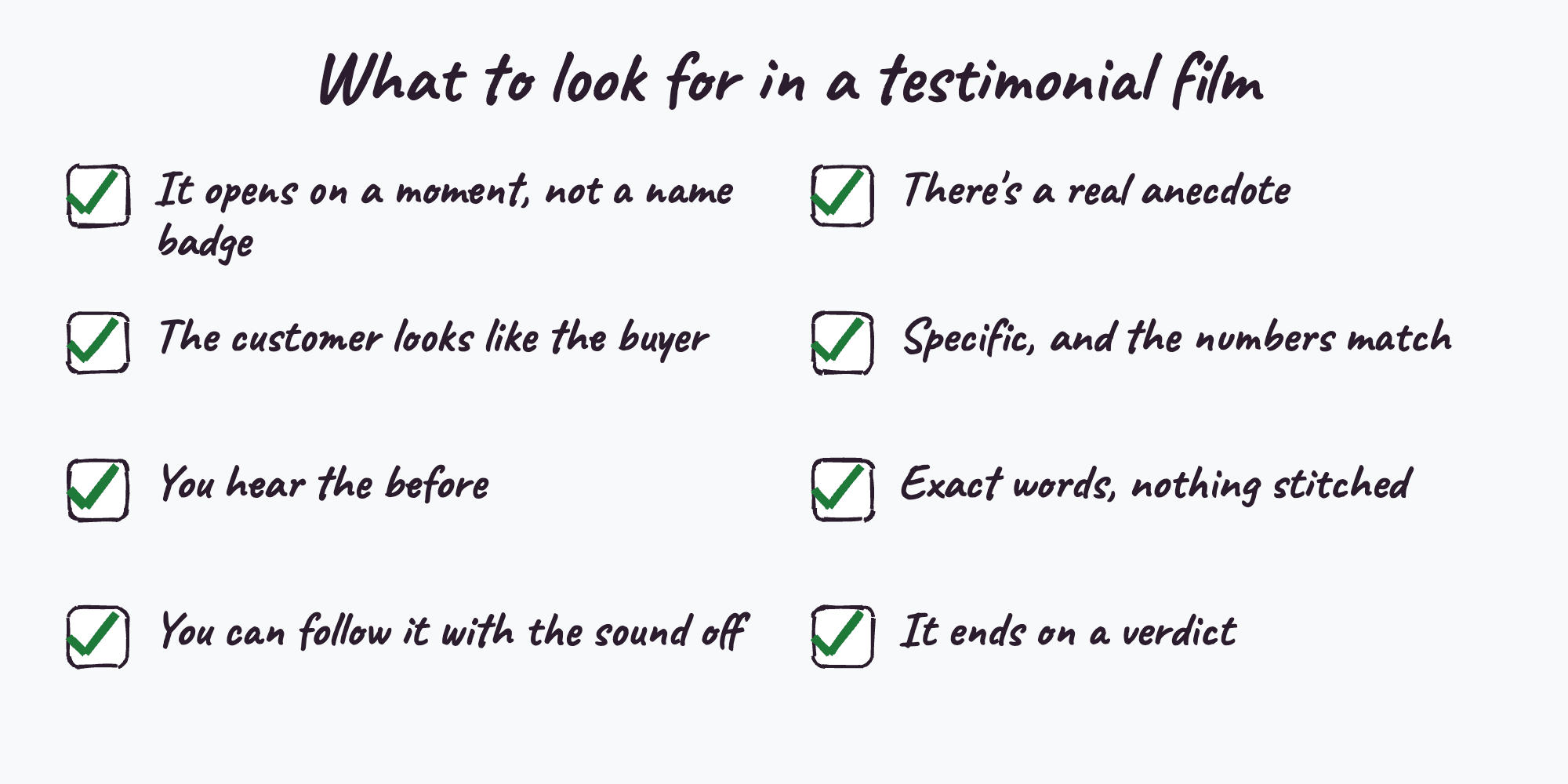
1. It opens on a moment, not a name badge
Watch the first ten seconds. A lot of testimonial films open with "Hi, my name is Sarah, I'm the operations director at…", which is information a viewer doesn't need yet and the fastest way to lose them.
A strong film opens on the problem, told as a moment: the day it went wrong, the worry that kept them up, the thing that couldn't carry on. The name and job title can appear on screen while they're talking.
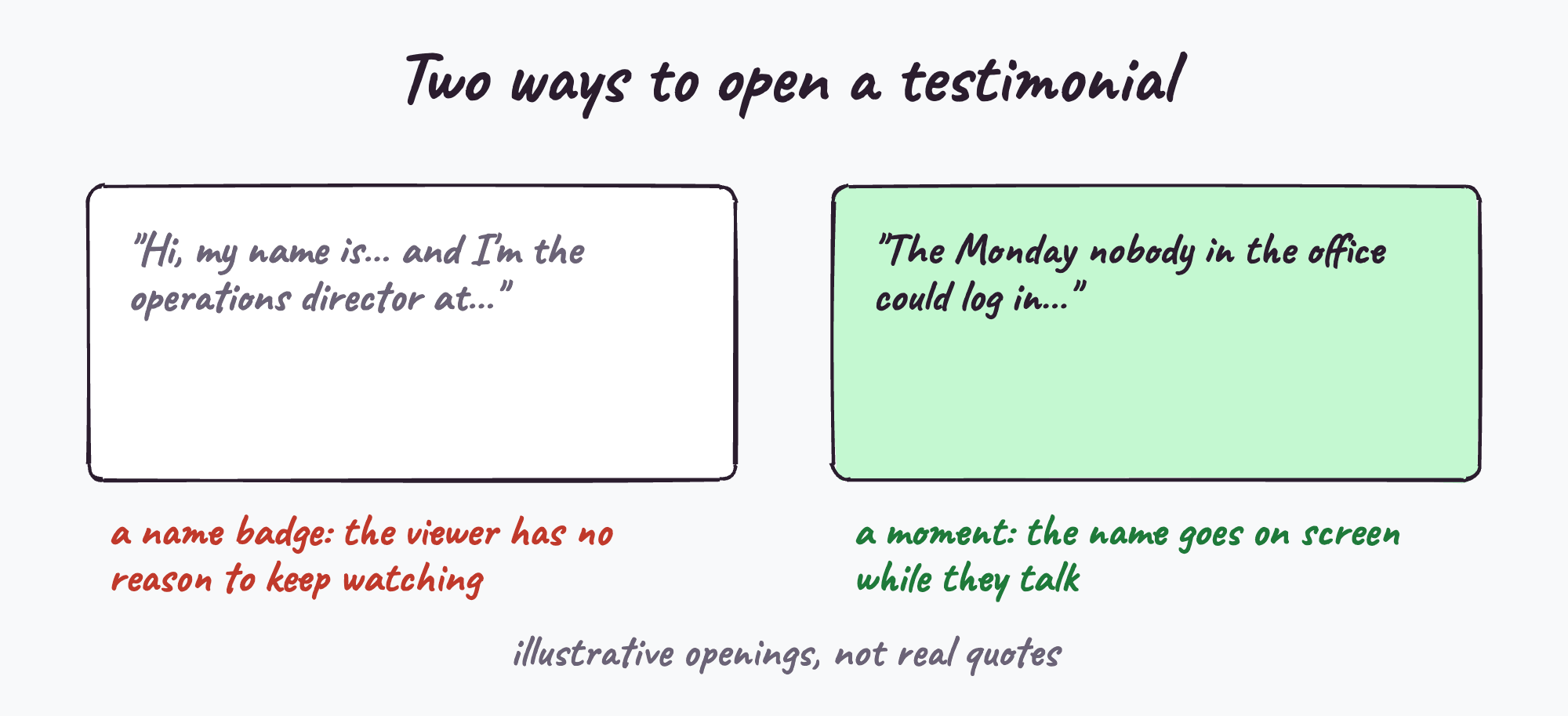
2. There's at least one real anecdote
An anecdote is something that happened once, to identifiable people, at a time you could point to, where something changed. "Our support is much better now" is a summary. "First time in January this year, I went on holiday and did not take my work with me" is an anecdote.
If a film has no anecdote, it can be beautifully shot and perfectly pleasant and still leave nothing behind. When you watch a sample, try to repeat one specific thing the customer said a minute later. If you can't, the interview didn't find a story.
3. The customer looks like the buyer
A testimonial is there to make a buyer think "that's us". So the customer should be recognisably a peer: the same kind of business, similar size, a job title the buyer has or reports to, and a problem they share. A glowing film from a company that looks nothing like your prospects persuades far less than you'd expect.
When you're judging someone's sample reel, ask whether the films feature businesses like yours. When you're commissioning your own, the same question applies to who you pick. I've covered that in which client should you ask for a testimonial?
4. It gets specific, and the numbers match what was said
Specifics are what make a claim believable: the number of offices, the weeks the project took, the tickets that stopped arriving. And every number in a headline, a caption or a graphic should be something the customer actually said. If they said "about 20%", the title shouldn't say 30%. If they said "50 to 75%", it shouldn't say 75%.
5. You hear the before
A film that starts at "they're great" skips the part that persuades. The buyer needs to hear what things were like before, why the customer changed, and what they were worried about, because that's the situation the buyer is in right now. Every result in the film should trace back to a problem stated earlier in it.
The whole system was very slow because it was so outdated. And quite often I would come in to staff not being very happy because they hadn't been able to access something and the support was quite intermittent and slow from the service provider.
6. Every sentence is one the customer actually said
This is the one most buyers never think to check. An editor can take half a sentence from minute six and half from minute thirty and join them into a line the customer never said. It sounds smooth, and it isn't their testimonial any more.
A good film keeps each quoted sentence as a continuous run of the customer's words, trimmed at the start or end if needed. Tidying "um"s and restarts is fine. Stitching different statements together isn't. It's worth asking any provider directly how they handle it.
7. Each clip makes sense on its own
Short clips get watched out of context, so each one needs to stand alone. A clip that opens with "And that's when they…" leaves a viewer wondering who "they" are and what "that" was. Good editing, and a good interview that gets full sentences, avoids it.
8. It looks like a conversation, not an advert
The customer should sound like someone talking to a colleague, not like someone reading from a script or performing for a camera. Staged or over-coached delivery is exactly what a sceptical buyer is primed to discount. Slightly unpolished and obviously genuine beats slick every time.
9. It's short enough to finish
The full story shouldn't need much more than about four minutes, and short clips for sales and social should be under a minute and about one thing each. If a sample film drags, the edit hasn't made enough decisions.
10. You can follow it with the sound off
Plenty of people watch in an office or on a train with the sound off. Captions should be burned in, accurate, and spell every name correctly, including the supplier's own brand. Automatic captions left unchecked are a common and avoidable embarrassment.
11. The name, role and company are on screen
Early on, a clean caption with the customer's name, job title and company. A viewer believes a named person far more than an anonymous one, and a buyer needs the job title and company to decide whether this person is a peer.
12. The music never fights the voice
Music is fine. Music that swells under someone's best line, or pulses through the whole film, competes with the person you're supposed to be listening to. If you notice the music, there's too much of it.
13. It ends on a verdict a buyer can use
The last word should be the customer's recommendation, ideally in answer to "what would you tell someone in your position who's weighing this up?", and it's the natural place for them to name the supplier.
I can't even remember if it took an hour. The whole platform is so self-explanatory.
A line like that answers a specific worry, onboarding time, far better than a general "I'd recommend them".
The simplest test of all
Would you watch it to the end even if you weren't a buyer? A good testimonial is a good story first. If you'd switch off, so will your prospect.
Questions people ask
How long should a video testimonial be?
The full story works well at up to about four minutes, with short clips of under a minute, each about one topic, for sales emails, service pages and social posts.
Should a video testimonial be scripted?
No. Scripted answers sound scripted, and buyers discount them. A good interview gets the customer talking naturally, and a good edit keeps their exact words.
What should a video testimonial include?
A real moment or anecdote, the situation before, what changed, specific details, the customer's name, role and company on screen, captions, and a clear recommendation at the end.
How can you tell if a testimonial has been edited misleadingly?
Watch for sentences that change pace or tone halfway through, or cut away just as a key line is delivered, and ask the provider directly whether quotes are ever joined from different parts of the interview.
Related reading
- Testimonial interview questions for MSPs
- Questions to ask before you hire a testimonial company
- Why most MSP testimonials don't work
Every film we make is checked against this list, and every quote against the recording, word for word.
See how it worksJames interviews MSP and tech vendor customers for a living and runs MSP Testimonials, the interview-led testimonial service. If a customer of yours has a story worth telling, this is how it gets told.