CSAT or NPS: which should an MSP measure, and what about tech vendors?
What each score is, how you collect it, what it can't tell you, and the one thing a survey can never be
 8 min read
An MSP should run CSAT on every closed ticket and a short NPS survey to each client's decision maker once or twice a year. A tech vendor should run NPS with the people who use the product, a separate partner NPS with the MSPs who sell it, and CSAT on its own support desk. CSAT tells you how the last interaction went, NPS tells you how the relationship stands, and neither one is something a prospect can see.
Every MSP I've worked with has a CSAT number somewhere, usually a smiley-face percentage on a dashboard that everyone is quietly proud of and nobody can explain to a prospect. NPS comes up less often, and usually because a vendor asked for it. So here's the plain version of what each one is, how you collect it, what it can't tell you, and which one you should be running, for an MSP and for a vendor selling to or through MSPs.
What is CSAT, and what does it measure?
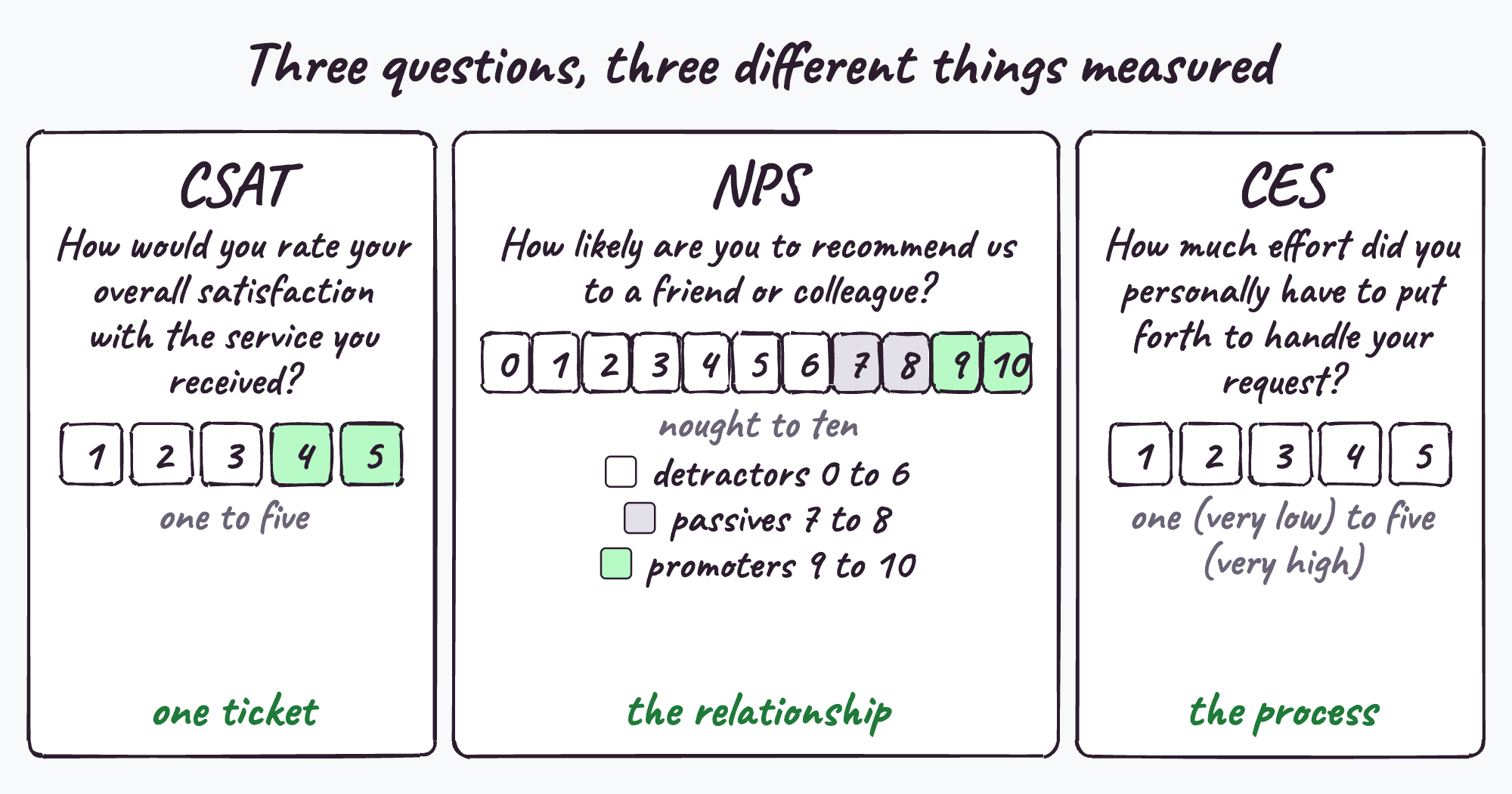
CSAT is short for customer satisfaction score, and it's the simplest of the three. You ask one question about one thing that just happened, usually some version of how would you rate your overall satisfaction with the service you received, on a scale of one to five, and the score is the share of answers that were a four or a five.
Because it asks about a single interaction, it's a transactional measure: it tells you how Tuesday's ticket went for the person who raised it, and nothing about whether the owner of that company, who has never raised a ticket in her life, is about to put the contract out to tender.
What is NPS, and why does everyone argue about it?
Net Promoter Score comes from a 2003 Harvard Business Review article by Fred Reichheld of Bain, and the question is how likely are you to recommend us to a friend or colleague, on a scale of nought to ten. Nines and tens are promoters, sevens and eights are passives, and anything from nought to six is a detractor. The score is the percentage of promoters minus the percentage of detractors, so it runs from minus 100 to plus 100, and a company where everyone gives you an eight scores zero.
That last point is where the arguing starts. A room full of contented sevens and eights produces an NPS of nothing, which feels harsh until you accept the argument behind it: Reichheld's claim was that the people who would actually recommend you are the ones who drive growth, and "fine, thanks" doesn't. Argue with the growth claim if you like, but nobody disputes that it's a relationship measure, asked periodically, about the whole of you rather than one ticket.
What about Customer Effort Score?
The third one you'll see is CES, from a 2010 HBR piece by Matthew Dixon, Karen Freeman and Nick Toman. They studied more than 75,000 people who had dealt with a contact centre or a self-service channel and found that what predicted loyalty after a service interaction was how much effort the customer had to make, so the question is how much effort did you personally have to put forth to handle your request, scored from one (very low) to five (very high). In their data CES beat both NPS and CSAT at predicting whether a customer would stay and spend more, and they called CSAT "a poor predictor".
For an MSP that's worth a moment's thought, because a helpdesk is nothing but service interactions. If your clients have to chase, repeat themselves, or ring after the portal failed them, a happy face on the final ticket won't tell you that. CES will.
How should an MSP collect them?
CSAT goes on the ticket. Every PSA in this market can fire a one-click survey in the ticket-close email, and the tools built for MSPs (SmileBack, Crewhu, Simplesat and Customer Thermometer, compared here) exist to make that click as painless as possible and to file the answer and the comment against the ticket, the engineer and the client. It has to be one click, because a five-question form in a closed-ticket email gets ignored by everyone except the small group of people who fill in forms.
NPS goes to a different person, on a different clock. The mistake I see most is sending the recommend question to whoever raised the last ticket, who doesn't own the relationship. Send it to the person who signs the contract, once or twice a year, with one open question underneath it, and read the comments before you look at the number. With thirty or forty clients the number will jump every time three people change their mind, and the comments won't.
How should a tech vendor collect them?
A vendor has two audiences, and which ones you measure depends on whether you sell to MSPs or through them. If you sell to them, the MSP is your customer: run NPS on the product with the people who use it every day, and CSAT on your own support desk. If you sell through them, partner NPS asks the same recommend question of the MSPs who resell you, and what they're really scoring is how easy you are to do business with: margin, deal registration, whether support picks up when their client is on the phone, whether your rep turns up. A vendor with a strong product NPS and a poor partner NPS is a vendor whose partners are quietly leading with somebody else.
Which should you use, then?
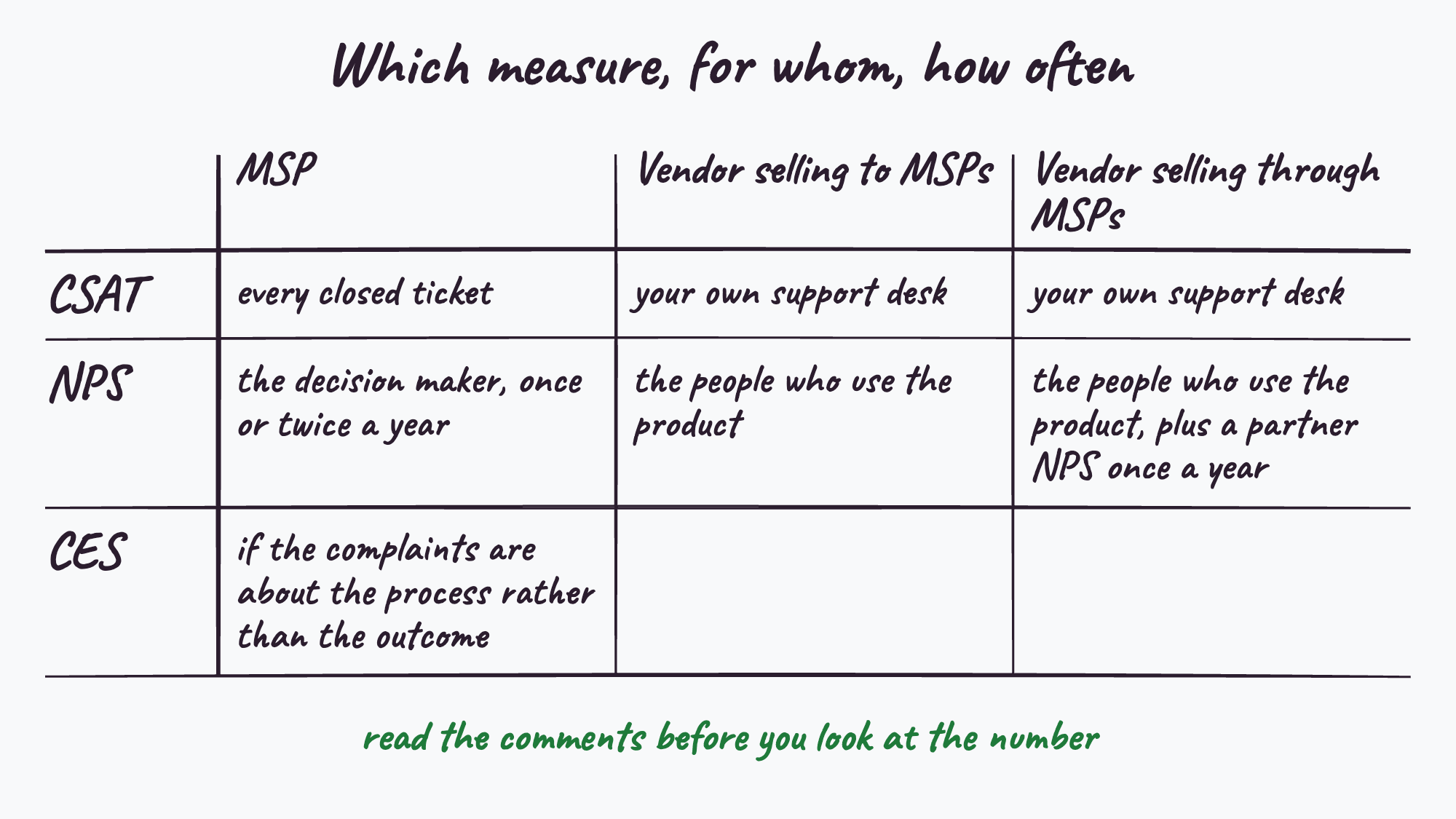
For an MSP: CSAT on every closed ticket and NPS to the decision maker at each client once or twice a year, with CES added if the complaints are about the process rather than the outcome. For a vendor selling to MSPs: product NPS and support CSAT. For a vendor selling through them: the same, plus a partner NPS once a year, with the comments read by the channel chief rather than filed by marketing. What none of them tells you is why, so the open comment box matters more than the scale. The number gets you to the right conversation. The comment tells you what to say when you get there.
The honest limits
Response rates first. Survicate's 2025 benchmark report, across 4,332 surveys at 460 companies, put the median B2B survey response rate at 8.18% (last checked 15 September 2026). One-click ticket surveys do much better than that: Simplesat's own guidance is that 20 to 30% is common for CSAT and above 40% is strong, and Customer Thermometer publishes rates its customers report, including an IT helpdesk at around 80% (both last checked 15 September 2026). Those are vendors describing their own users, but whatever your rate, remember who's in it: a CSAT built from a quarter of your tickets is a survey of the people who bother, and the people who bother skew towards the delighted and the furious.
Survey fatigue is mostly self-inflicted. A client who gets a smiley face on every password reset stops seeing them within a month, so plenty of MSPs survey only tickets over a certain length, and NPS sent quarterly to a small base is another way to train people to ignore you.
Gaming happens wherever a bonus is attached, and it rarely looks like fraud: engineers ask for the green face while they're still on the call, tickets get split so a good outcome counts twice, and the NPS goes only to the accounts that had a good quarter. All of it makes the number describe your team's incentives rather than your clients' experience, so if you pay on CSAT, audit it.
The MSP survey tools each show you a comparison against their own customer base inside the product, but none of them, as far as I could find, publishes that figure openly with a year and a sample size attached (last checked 15 September 2026), and they don't score the same way, so a 97% from one tool and a 4.3 from another aren't the same measurement. Compare yourself with yourself.
When this isn't right for you
If you're an MSP with fifteen clients, or a vendor with a dozen partners, you don't need an NPS programme; you need to ring those people once a year, ask them the question yourself, and write down what they say. Surveys exist because at some size you can't talk to everyone, and if you can, talk to them. And if nobody reads the comments and acts within the week, stop surveying until somebody will, because a survey that's never acted on reminds the client monthly that you asked and did nothing.
A score is a signal, a customer on the record is proof
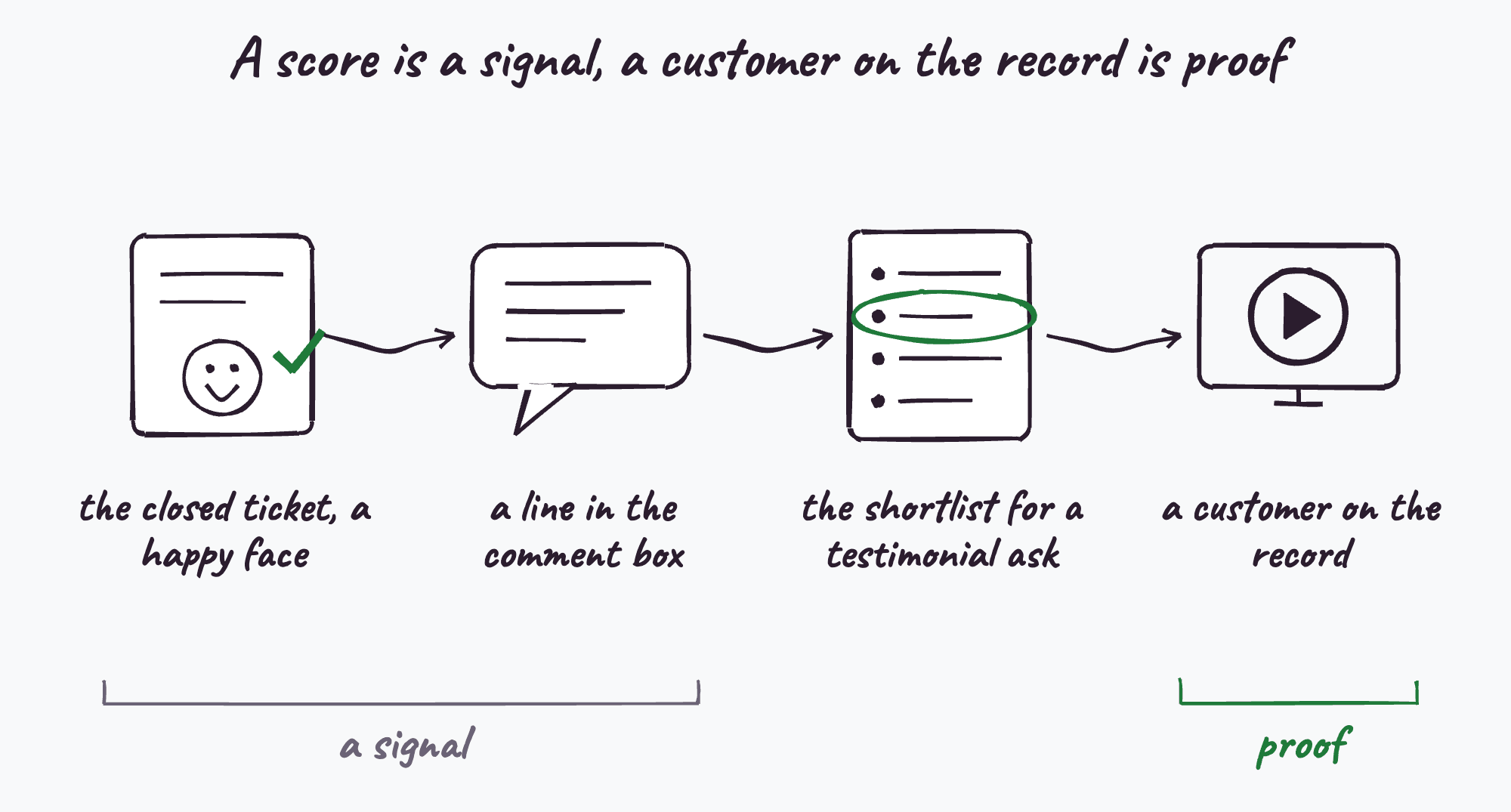
Here's the bridge, and I'll say it once. A CSAT of 96% is something you know, and on your website it reads like every other MSP's 96%, because a prospect has no way to check it. The moment behind the score, when a client writes a line in the comment box naming the engineer who got them working again before lunch, is proof with a name on it. So the most useful thing your CSAT tool gives you is a dated list of the people who were happy enough to write something down, which is the best shortlist for a testimonial ask you'll ever have. How to turn that list into a habit is in turn your helpdesk into a testimonial engine, and how to choose between the names on it is in which client should you ask for a testimonial?
Questions people ask
Is NPS or CSAT better for an MSP?
Both, for different jobs: CSAT on every closed ticket tells you how the desk is doing this week, and NPS to each client's decision maker once or twice a year tells you how the relationship stands.
What is a good CSAT score for an MSP?
There is no openly published, dated MSP benchmark I could find (last checked 15 September 2026), so track your own score quarter on quarter and read the comments.
Related reading
- Turn your helpdesk into a testimonial engine
- Which client should you ask for a testimonial?
- CSAT survey tools for MSPs compared
- How do you know if a testimonial is working?
- Five ways to get testimonials from your clients
The clients who write a comment on a closed ticket are the ones who'll say it on camera. We'll handle the asking.
See how it worksJames interviews MSP and tech vendor customers for a living and runs MSP Testimonials, the interview-led testimonial service. If a customer of yours has a story worth telling, this is how it gets told.