How much does a video testimonial cost?
Real prices from every kind of provider, what each one is actually charging you for, and the costs that never make it onto the invoice
 8 min read
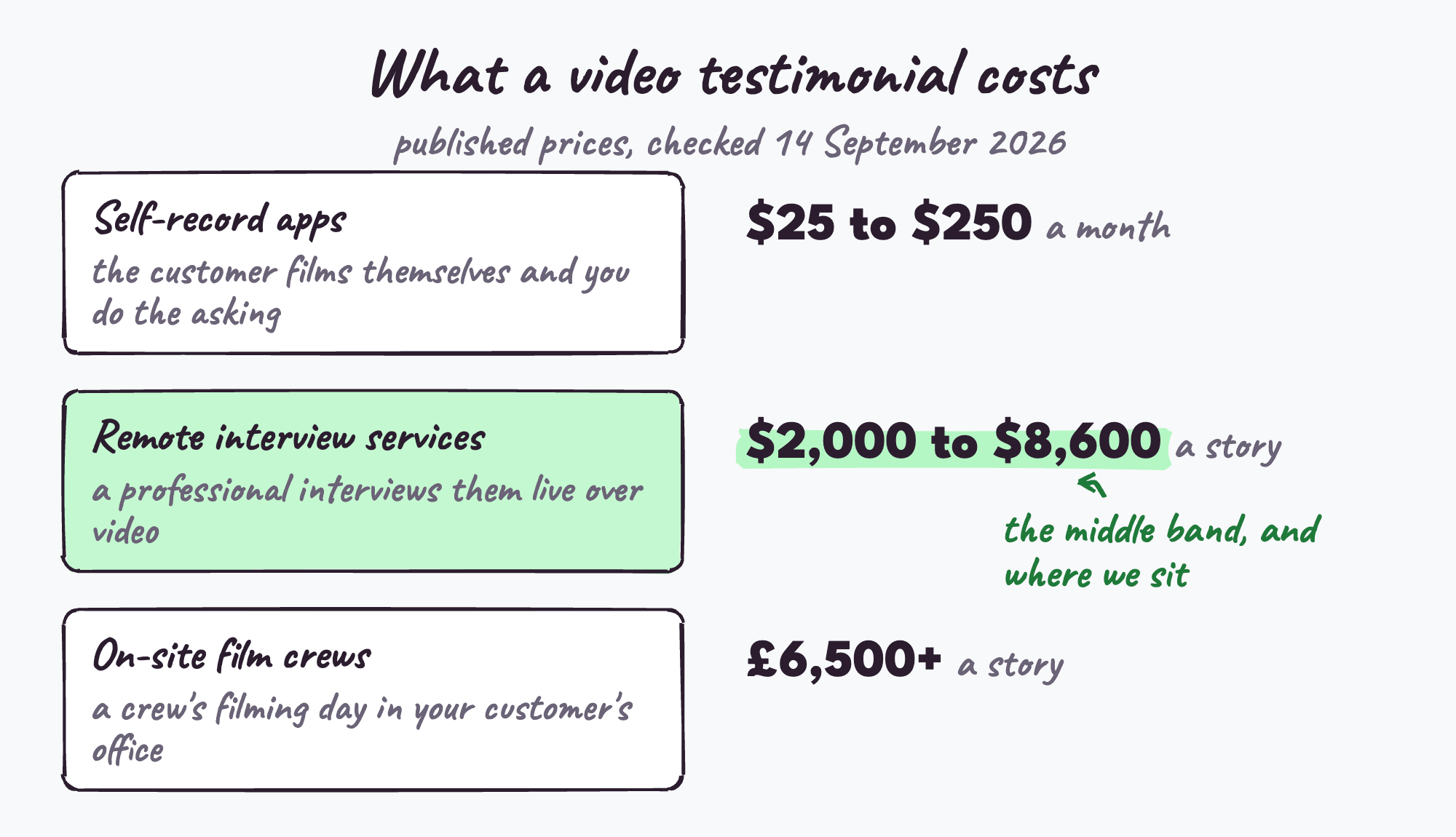
A customer video testimonial costs anything from a free app to well over £10,000. Self-record software runs from about $25 to $250 a month, remote done-for-you services publish prices from roughly $2,000 to $8,600 a story, and on-site film crews start around £6,500. MSP Testimonials charges $2,295 for one story, and less per story in a pack.
Those ranges are wide enough to be useless on their own, which is exactly why most people searching for this give up and book three discovery calls. So this is the version I'd give a friend who runs an MSP and asked me over a pint: what each kind of provider is actually charging you for, where the cheap options quietly move the cost onto you, and what we charge, in full, with nothing held back for a call.
I've put real, published prices in here, including other people's, with links. They were correct when I last checked them, on 14 September 2026, and prices move, so click through before you budget against anyone's number, ours included.
What are you actually paying for?
Every testimonial, however it gets made, needs three jobs doing. Somebody has to get a yes and a date in the diary, somebody has to run the conversation, and somebody has to turn the recording into something a buyer will watch and a salesperson will send.
The price of each option mostly tracks how many of those three jobs it does for you. That sounds obvious, but it's the thing that makes the cheap end look cheaper than it is, because the two jobs a £30-a-month app hands back to you are the asking and the interviewing, and those are the two that decide whether you end up with anything worth publishing.
Why is self-record software so cheap?
Because the customer does the filming and you do the chasing. Tools like Testimonial.to, Vocal Video, Boast and StoryPrompt send your customer a link, show them a handful of prompts, and let them record answers on their laptop or phone. Plans run from free tiers up to about $250 a month, with enterprise pricing above that.
For the right job they're genuinely good. If you want a steady trickle of short, honest clips from happy customers, and someone on your team will send the links and nudge people, the maths is hard to argue with.
What you don't get is anyone in the room. A prompt can't hear that the customer just mentioned, almost in passing, the Monday the whole office lost email, and it can't say "hold on, take me back to that". So you tend to get what people say when asked to be nice about a supplier on camera with nobody listening, which is a sentence or two of general praise. That has its uses. It isn't a story, and it rarely changes a buyer's mind about switching.
Why do on-site film crews cost so much more?
Because you're paying for a crew's day, their kit and usually their travel, and a filming day is expensive whether the interview is any good or not. Here Now Films, a London agency, publishes £6,500 and up for a filming day, a two to three minute film and two social cuts, with four to six weeks to delivery. Testimonial Hero lists average on-site costs of $9,200 to $13,348 a story on an annual plan.
What that money buys is real: location footage, a second camera, the office, the people walking about, lighting somebody has thought hard about. For a big brand launching a flagship story, that's worth having.
For most MSPs and most of the vendors who sell to them, it's the wrong place to spend. Your buyer isn't judging the lighting, they're asking whether somebody who looks like them had the problem they have and got out of it. A crew doesn't make that answer any better, and a travel day is the fastest way I know to make a good story unaffordable.
What do remote, done-for-you services charge?
This is the middle band, and where we sit. A professional runs the interview live over video, the customer records at their own desk, and the provider does the edit and everything made from it.
Published prices in this band vary a lot. Remote Video Testimonials quote $2,000 for a single video in their FAQ. Testimonial Hero's remote tiers average $3,800 for video alone, up to $8,600 for video plus written assets, on a 12-month credit plan. The differences come down to what's in the box, how fast it ships, and who is actually asking the questions.
What does MSP Testimonials cost?
Here's all of it.
- Single$2,295one story
- 3-Pack$5,995$1,998 a storyor $2,095 a month for 3 months
- 6-Pack$11,495$1,916 a storyor $1,995 a month for 6 months
- 12-Pack$20,495$1,708 a story
- 24-Pack$36,495$1,521 a story
All prices are exclusive of VAT, which is added at checkout.
We price in pounds, euros, US dollars, Canadian dollars and Australian dollars depending on where you are, and every price on this page is already in yours. The monthly plans cost a little more than paying up front (three payments of $2,095 come to $6,285 against $5,995), and that's the honest trade for spreading it.
Every story includes the interview, which I run myself, the asking and the scheduling, a full film, a teaser, five shorts, the graphics, a sales battlecard, a case study, a one-page sales guide, the posting copy, the emails, the blog post and the rest. It's 48 pieces in all, and what's in the pack walks through every one and what it's for. The pack lands 14 working days after the interview. And every step of making it is manual: the questions, the interview, choosing the moments, the edit notes, the editing and the review are all done by people, which is a fair part of what you're paying for.
What costs never make it onto the invoice?
Three, and the first one is the big one.
A film nobody uses. Most testimonials get made, posted once and filed, which makes the real price of that film whatever you paid divided by one LinkedIn post. Kaseya's 2026 State of the MSP report, drawn from 1,061 MSPs, found the share struggling to quickly demonstrate value to clients nearly doubled in a year, from 10% to 19%, and I'd bet a fair number of those businesses have a testimonial sitting on YouTube that could have done exactly that job. So whatever you buy, check it comes with a decision about where each piece goes and who sends it.
Your customer's time, and your goodwill with them. A 45-minute call is a reasonable thing to ask of a happy client. A two-hour shoot with a crew in their office, or a request to "just record a few thoughts" that they then have to work out how to do, costs more goodwill than people realise, and you only get to spend it once.
Your own time. Somebody has to write the intro email, chase the booking, brief the customer, sign it off and then actually post the thing. The self-record tools hand all of that to you. We do the asking and the chasing, which is a large part of why our price isn't £300.
When is the cheap option the right one?
More often than an agency will tell you. If most of your new business comes from referrals and your close rate is healthy, you may not need a produced film at all, and a steady flow of Google reviews plus the odd self-recorded clip will serve you well. If what you want is volume, twenty short clips of customers saying they're happy for a wall on your website, a self-record tool is built for that and we're not.
A produced, interviewed story earns its price when prospects are comparing you with a bigger or better-known competitor, when the deal involves someone switching away from an incumbent, or when you've launched something new that has no proof behind it yet. Those are the moments a buyer needs to see a peer who took the same risk.
How do you compare two quotes properly?
Ask each provider the same five questions and the prices start making sense:
- Who actually runs the interview, and do they know your market well enough that your customer won't spend ten minutes explaining what an MSP is?
- Who asks your customer, schedules them and chases them?
- What exactly arrives, in what formats, and how long after the recording?
- What can you do with it afterwards, and for how long?
- What happens if you're not happy with it?
For the record, our answers: I run every interview; we do the asking; the full pack lands 14 working days after filming; you get a perpetual licence to use it in your own marketing; and if we can't get it to a standard you're proud to publish, you get a full refund for that story (the terms spell out the exceptions, such as a customer withdrawing after filming).
Questions people ask
Is VAT included in the price?
No. All MSP Testimonials prices exclude VAT, which is added at checkout where it applies.
Can I spread the cost of a pack?
Yes. The 3-Pack can be paid at $2,095 a month for three months and the 6-Pack at $1,995 a month for six. Plans are committed orders, so every instalment is payable, and they cost slightly more in total than paying up front.
Do testimonial credits expire?
One credit unlocks each month from the day you buy, and every credit in the pack stays live until 24 months after the last one unlocks. A Single is good until month 25 and a 6-Pack until month 30.
What if I want more stories after using a 6-Pack?
Extra stories after a 6-Pack are charged at the 6-Pack rate of $1,916 each, so you keep the bulk price.
Why is a video testimonial cheaper than a normal video shoot?
Because it's recorded remotely. Your customer joins a video call from their own desk with a phone on a small tripod we post to them, so there's no crew, no travel and no filming day to pay for.
Related reading
- What you get from one testimonial interview
- How a remote video testimonial works, from booking to handover
- The best way to get video testimonials made: apps, agencies or a specialist
One customer, one 45-minute conversation, and the whole pack back 14 working days later. Same price for everyone, on the page.
See the pricingJames interviews MSP and tech vendor customers for a living and runs MSP Testimonials, the interview-led testimonial service. If a customer of yours has a story worth telling, this is how it gets told.