How long does a testimonial stay useful?
There's no expiry date, and anyone who quotes you one is guessing. What actually makes a testimonial go stale, and what to do about it
 5 min read
There is no research-backed expiry date for a testimonial. A story stays useful while it's still true: the person still works at the company, the company is still a customer, the service they describe still exists, and the numbers still hold. Date every story, check them once a year, and refresh or retire the ones that fail those tests, rather than replacing everything on a fixed schedule.
You'll see confident advice that testimonials go stale after three months, six months, a year. I went looking for the research behind those numbers and couldn't find any for B2B testimonials. Some come from surveys of consumers reading reviews of restaurants and shops, and some trace back to nothing at all. Nobody has measured how quickly a business buyer stops trusting a customer story because of its age.
What I can tell you is what actually makes a testimonial stop working, because that's much more specific than a date, and much more useful.
What actually makes a testimonial go stale
The person has left the company. A buyer who looks them up, or rings the switchboard, finds they've moved on. The story didn't become false, but the endorsement has lost its current voice.
The customer has left you. A story on your homepage implies the customer is still happy today. If they've gone, it's no longer a fair picture, and a prospect who checks will find out.
The thing they praised has changed. A testimonial about a service you've since dropped, a platform you've replaced or a process you no longer run can mislead someone who buys on the strength of it.
A number in it is out of date. "We cut our tickets in half last year" written in 2023 and still headlined in 2026 is making a claim nobody has checked.
Your newest story is visibly old. Even if every individual story is still accurate, a library whose most recent story is four years old says something about the business now.
What doesn't make a testimonial stale
Age on its own. A three-year-old story that's still accurate, from a customer who's still with you, told by someone who's still there, is still doing its job. It fades a little as newer stories join it, which is fine. It doesn't do harm.
This matters because the alternative, throwing out everything older than a year, wastes good proof. The best approach is to keep accurate older stories and add new ones on top.
There's a search angle too. When Promptwatch looked at which YouTube videos AI tools cited in February 2026, 54% were more than two years old. That's a small sample and a single vendor's dataset, and it's about what AI tools cite rather than what persuades buyers, but it's a reminder that older material isn't automatically worthless.
What the rules say about endorsements that are out of date
The US Federal Trade Commission's Endorsement Guides are a sensible yardstick even outside the US. They say an advertiser can keep running an endorsement only while it has good reason to believe the endorser remains a genuine user of the product, and that a clearly dated historic post doesn't need to be deleted, although re-sharing it after something material has changed would need checking with the person first. As always, check the specifics with your own adviser.
The practical upshot: date your stories, and re-confirm before you put an old one back in front of people.
A yearly check that takes an afternoon
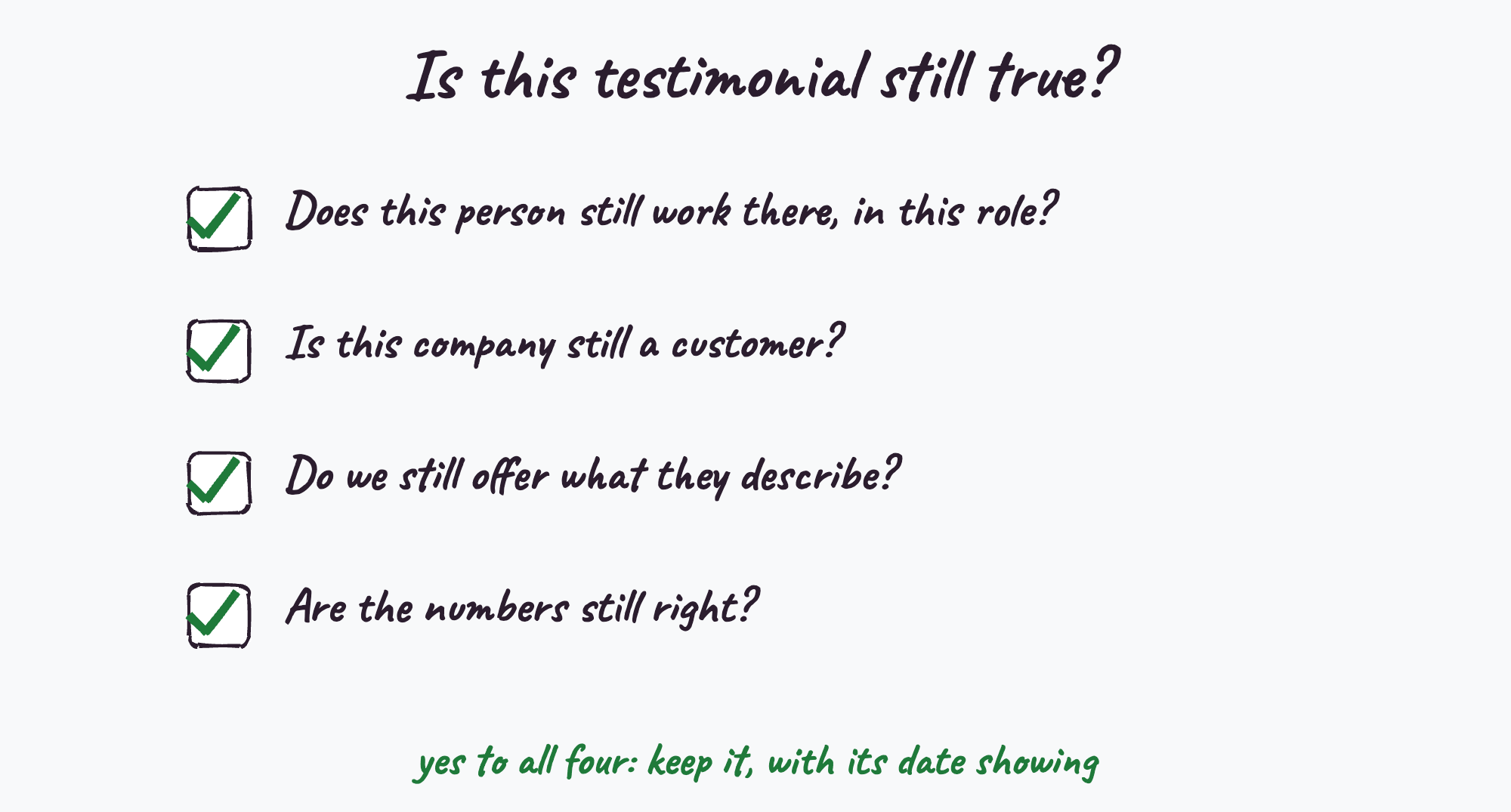
Once a year, go through each story and ask:
- Does this person still work at this company, in this role?
- Is this company still a customer?
- Do we still offer what they're describing, in the way they describe it?
- Are the numbers still true?
A yes to all four means the story stays, with its date visible. A no to any of them means one of the options below.
What to do with a story that fails the check
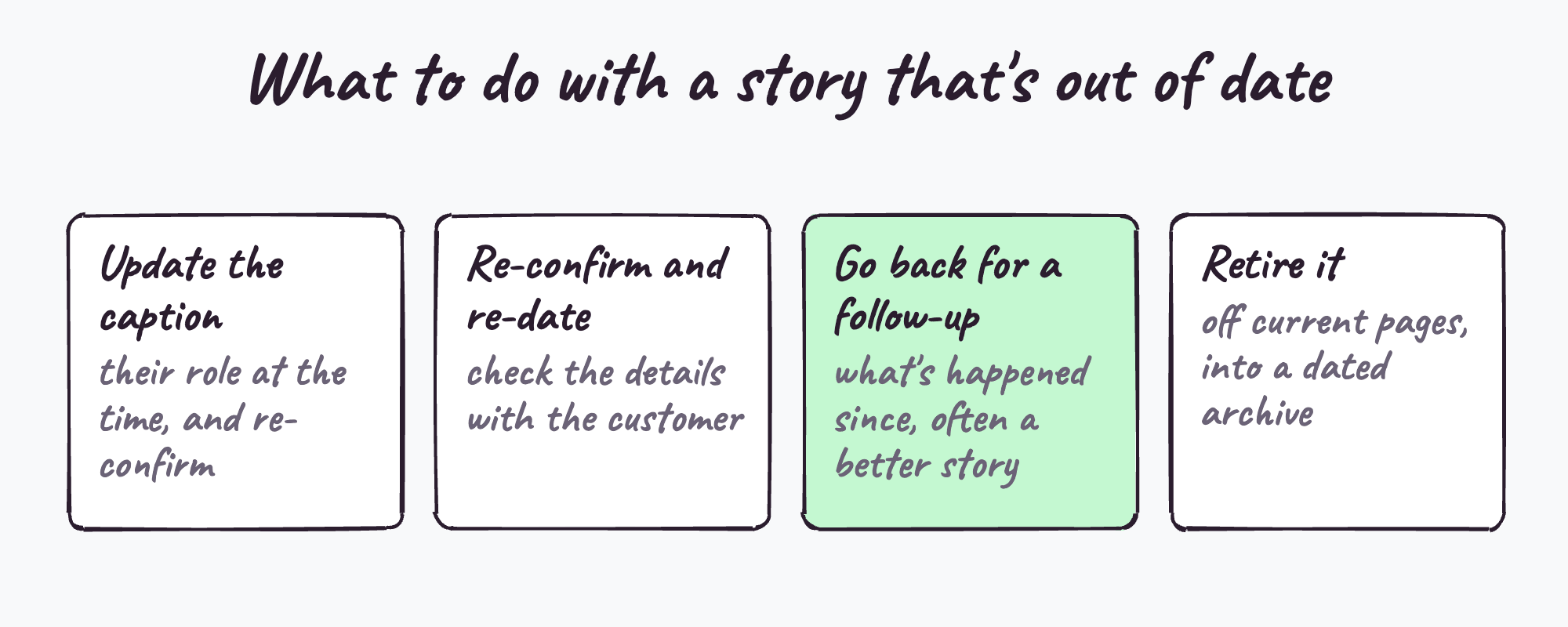
- Update the caption. If the person has moved on but the company is still a customer, show their role at the time, and re-confirm they're happy for it to run.
- Re-confirm and re-date it. If the numbers or details have shifted, check with the customer and update the surrounding text.
- Go back for a follow-up. A short conversation a year or two on, about what's happened since, is often a better story than the first one, because it shows the relationship lasted. It's also the easiest way to get an expansion story, about a service they added later.
- Retire it. If the customer has left or the service no longer exists, take it off your current pages and out of your sales material. Keep it in a dated archive if you like.
How to keep the library fresh
The simplest habit is a steady rhythm of new stories, such as one a quarter, chosen to fill whichever gap matters most, rather than a big push every few years. Your newest story is then never very old, and nothing needs replacing in a panic. There's more on choosing which gaps to fill in how many testimonials does your business need?
Questions people ask
Do testimonials expire?
Not on a fixed date. A testimonial stops being useful when it stops being true: the person has left the company, the customer has left you, the service has changed, or its numbers are out of date.
How often should you update testimonials?
Check every story once a year, and add new stories on a steady rhythm, such as one a quarter. Refresh or retire any story that's no longer accurate.
Should you show dates on testimonials?
Yes. A visible date is honest, helps a buyer judge how current a story is, and makes it easier for you to spot which stories need checking.
Is an old video testimonial still worth using?
If it's still accurate and the customer is still with you, yes. Add newer stories alongside it rather than taking it down.
Related reading
- Who owns a testimonial, and what happens if the customer leaves?
- How many testimonials does your business need?
- How do you know if a testimonial is working?
A follow-up story with a long-standing customer is one of the easiest to get and one of the most persuasive. We'll handle the asking.
See how it worksJames interviews MSP and tech vendor customers for a living and runs MSP Testimonials, the interview-led testimonial service. If a customer of yours has a story worth telling, this is how it gets told.