Video testimonial vs written case study vs Google reviews
Three kinds of proof, three different jobs, and why an MSP that picks only one leaves a gap a competitor walks straight through
 6 min read
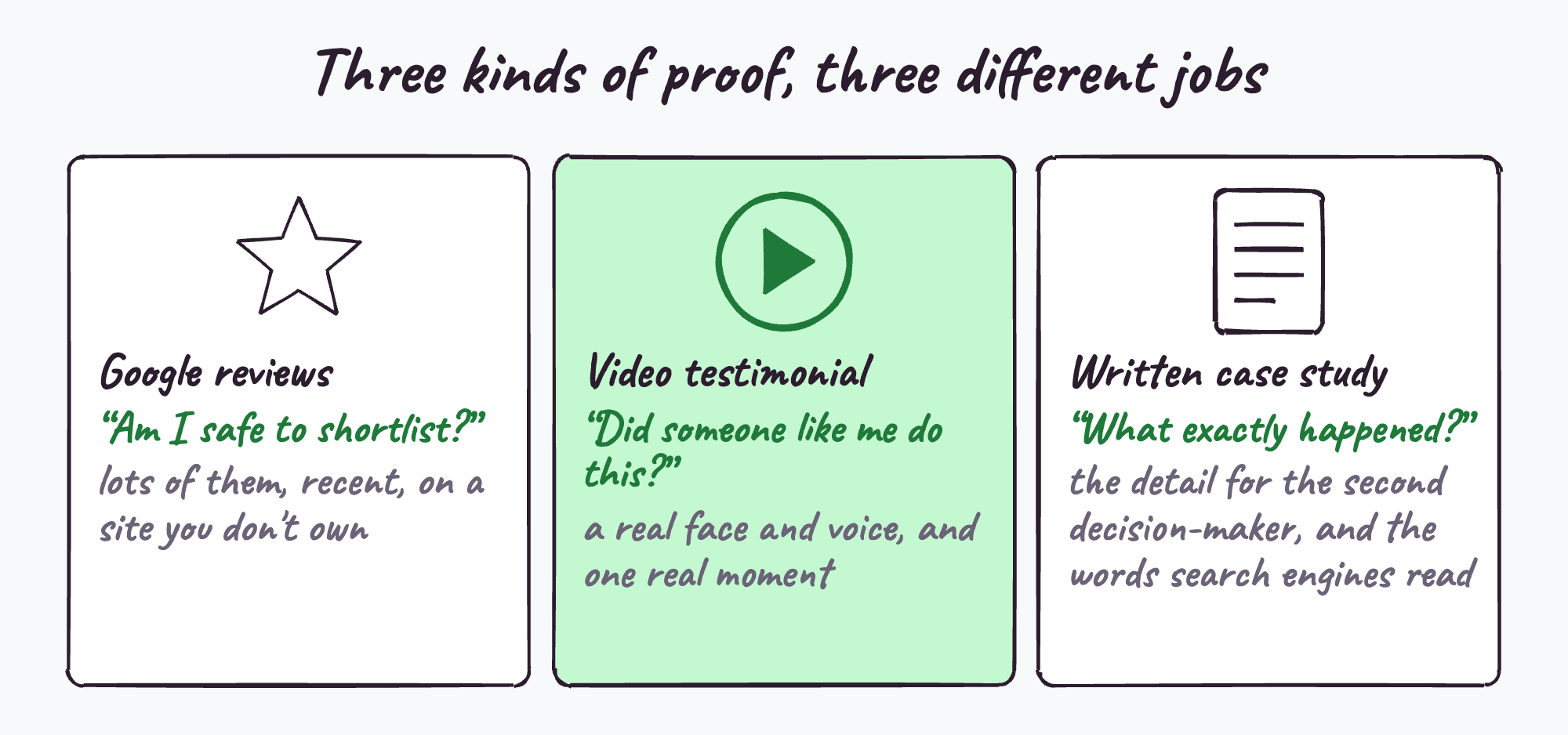
Video testimonials, written case studies and Google reviews do three different jobs. Reviews show a buyer you are safe to shortlist. A video testimonial convinces the person making the decision, because they can see and hear a peer. A written case study gives the detail to everyone else involved, and it is the version search engines and AI tools can read. Most MSPs need all three.
The question usually arrives as a budget question: we can afford a written case study, so we'll start there and do video when we're bigger. Or the other way round, we'll do a video because nobody reads PDFs. Both answers treat the formats as more and less expensive versions of the same thing, and they aren't, any more than a proposal is an expensive version of a phone call.
Each format turns up at a different moment in a buying decision, in front of a different person, asking a different question. Get that straight and the choice of what to make first gets much easier.
What are Google reviews for?
Reviews answer the first question a buyer asks about an unfamiliar business, which is whether it's safe to consider at all. Plenty of reviews, recent ones, with real names and the odd specific detail, tell a buyer that other businesses use you and nothing has gone badly wrong.
They also count for more because you don't control them. Google tells its own quality raters to be sceptical of what websites say about themselves and to look up a company's reputation elsewhere, and it has stopped showing review stars for reviews a business hosts about itself on its own site (Google's review snippet guidelines). A 2018 study of purchasing professionals found reviews from an external professional community carried more weight than a vendor's own scorecards (Steward, Narus and Roehm).
What reviews can't do is tell a story. "Brilliant service, always quick to respond" is a comfort, but it won't persuade anyone to leave the provider they already have.
What is a video testimonial for?
A video does the persuading. It's the one format where a buyer sees a person who looks like them, in a job like theirs, describing a problem they recognise, and hears in their voice that it got better.
That isn't just a hunch. In a set of experiments published in Communication Research, testimonials were more persuasive delivered as audio than as written text (Braverman, 2008), and a large study of online reviews found that reviewers who disclosed their real identity were rated as more helpful, with a measurable effect on sales (Forman, Ghose and Wiesenfeld, 2008). A named person on camera is about as identifiable as proof gets.
The film is also the thing a salesperson sends. A two-minute clip of a customer answering the exact objection a prospect just raised does more on a stalled deal than any document, which is why every pack we make has a short cut specifically for that job.
I think the whole staff team was so pleasantly surprised that it was really, really smooth.
That line, from Cheryl's interview, answers "will the move upset my team?" better than any sentence Urban Network could write about themselves.
What is a written case study for?
Two jobs, and people usually only think of the first.
It gives the detail to the second person in the room. B2B decisions rarely rest with one person. The owner watches the film, then forwards something to the finance director, the operations lead or the person who will actually manage the relationship, and that person wants to read the specifics at their own pace. The same Braverman research found that for people who are highly involved in a decision and like to think things through, detailed information outperformed a testimonial. That's your technical evaluator, and the case study is for them.
A study of UK small and medium-sized businesses buying services found they preferred more elaborately written references, and that a bare wall of client logos only worked when it came with a word-of-mouth recommendation (Tóth, Nieroda and Koles, 2020).
It's the version machines can read. A search engine or an AI assistant can't watch your film. It reads the words on the page. When Promptwatch classified what ChatGPT cited in July 2026, product and service pages made up 32.8% of citations and video 0.1%. So the written story on your website, with the customer's name and the specifics in plain text, is how the story becomes findable at all.
Which one should an MSP get first?
It depends where you're losing.
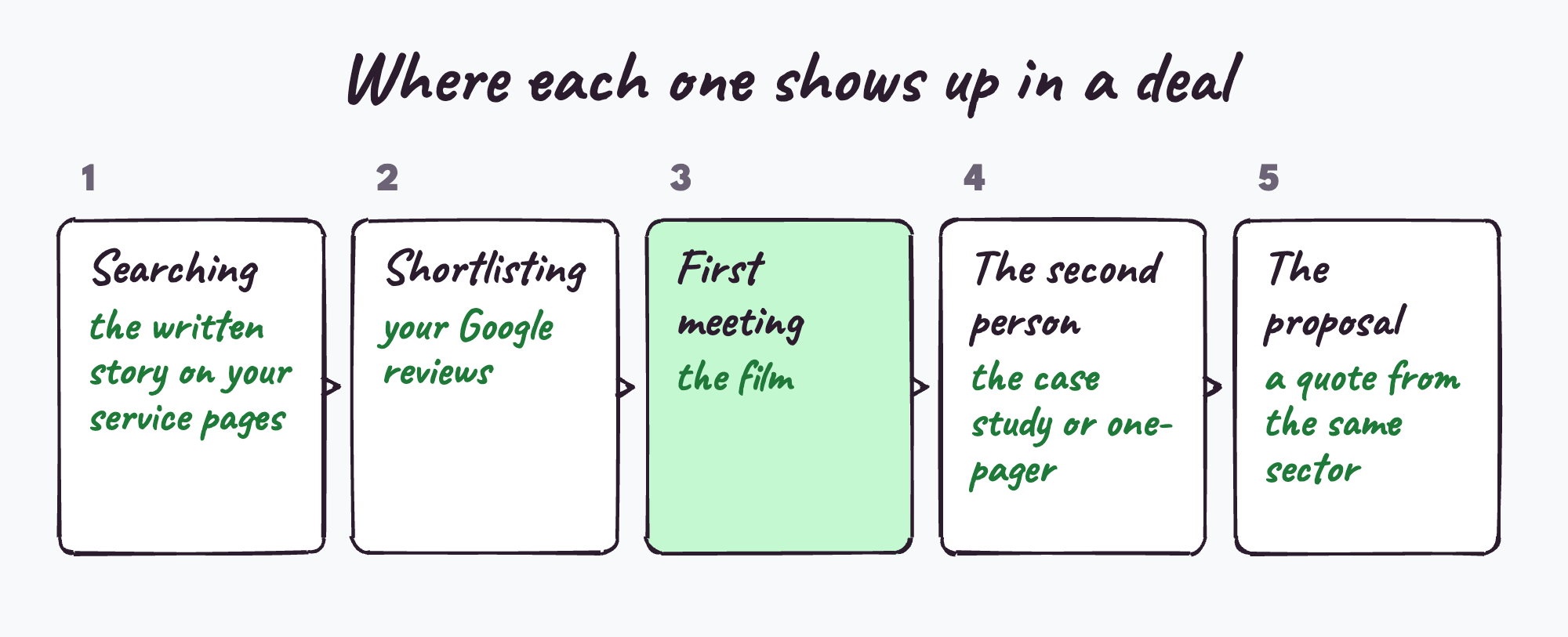
If you're not getting onto shortlists, start with reviews. They're free, they compound, and a buyer who can't find any will often not get as far as your website. Ask for them straight after something goes well, and never offer anything in exchange for a public review.
If you're getting meetings but losing to a competitor or to "we'll stick with who we've got", you need a video. That's a persuasion problem, and it's the one reviews and documents are worst at solving.
If deals stall after the first meeting, the case study is usually what's missing, because the person you met is trying to convince somebody you haven't met.
The good news is that the video and the case study don't need separate projects. One recorded interview gives you both, because the written version is built from the same conversation, word for word. We make both from every interview for exactly that reason, and ask your customer for a Google review in the same week, while they're still feeling good about it.
Can a written testimonial be as good as a video?
For some people, yes, and for search engines it's better. What writing can't carry is the voice, the face and the pause before someone says "I would be up that creek without a paddle". A buyer can tell the difference between a sentence a marketing team polished and a person saying something they obviously mean, and on camera there's no doubt which one they're getting.
The one thing to avoid in any format is anonymity. "A financial services client" convinces nobody, and if a customer genuinely can't be named, there are better options than anonymous, which I've covered in what to do when a client says no.
When isn't a video worth it?
If most of your work comes through referrals, your close rate against competitors is healthy, and your buyers are small local businesses who pick up the phone to people they already know, reviews and a good written story may well be enough. A film earns its cost when buyers compare you with someone bigger, when you're asking them to leave an incumbent, or when you've launched a service nobody has seen you deliver yet.
Questions people ask
Is a video testimonial better than a written one?
They do different jobs. Video is more persuasive for most buyers because they see and hear a real person, while a written case study gives detail to analytical readers and is the version search engines and AI assistants can read. The best approach is to make both from one interview.
Do Google reviews count as testimonials?
They're a form of social proof, and an important one, because they sit on a platform you don't control. They show a buyer you're safe to consider but rarely carry enough of a story to persuade someone to switch provider.
Should testimonials go on my own website if Google won't show stars for them?
Yes. Review stars are one display feature. A named customer story on your service pages still does its main job, which is convincing the buyer reading that page, and the written version helps search engines understand what you do and who for.
Can one interview produce a video and a written case study?
Yes. A recorded interview gives you the film, and the transcript gives you everything needed for a written case study, quotes included, word for word.
Related reading
- Where to put testimonials on your MSP website
- Do testimonials help you get found in AI search?
- What you get from one testimonial interview
One 45-minute interview gives you the film, the case study and the rest, all from the same conversation.
See what's in the packJames interviews MSP and tech vendor customers for a living and runs MSP Testimonials, the interview-led testimonial service. If a customer of yours has a story worth telling, this is how it gets told.