Do testimonials help you get found in AI search?
What ChatGPT, Perplexity and Google's AI answers actually read, what a customer story can do for you there, and the things people will try to sell you that do nothing
 6 min read
Testimonials can help an MSP or vendor get found in AI search, but through the written version rather than the video. ChatGPT, Perplexity and Google's AI Overviews mostly cite text on web pages, especially product and service pages, and very rarely cite video directly. Publish the customer story as text on your service pages, on its own page with the transcript, and on LinkedIn and YouTube with full written descriptions.
This is a subject with more confident nonsense attached to it than almost anything else in marketing right now. Every week somebody new is selling an AI visibility score, a special file for your website or a guaranteed spot in ChatGPT's answers, and very little of it survives contact with actual data.
So I'll stick to what's been measured, say where the evidence is thin, and be clear about what we don't claim. The short version is that a customer story helps you in AI search in the same way it helps you with a human buyer: by putting specific, credible, named evidence on the pages that matter. The difference is that a machine can only read it.
What do AI answers actually cite?
Web pages, overwhelmingly, and one kind in particular. When Promptwatch classified ChatGPT's citations for July 2026, product and service pages made up 32.8% of them, the biggest single category. Video was 0.1%. On Google's AI Overviews the picture was more balanced, with video at 5.9% and climbing, and product pages the most-cited format every day from 28 July.
That last number, from Promptwatch's sources-per-response data, matters more than it looks. With roughly five citations in an answer, "fairly relevant" doesn't get a slot. The page has to be the clearest answer to the question somebody asked.
So does the testimonial film do anything for AI search?
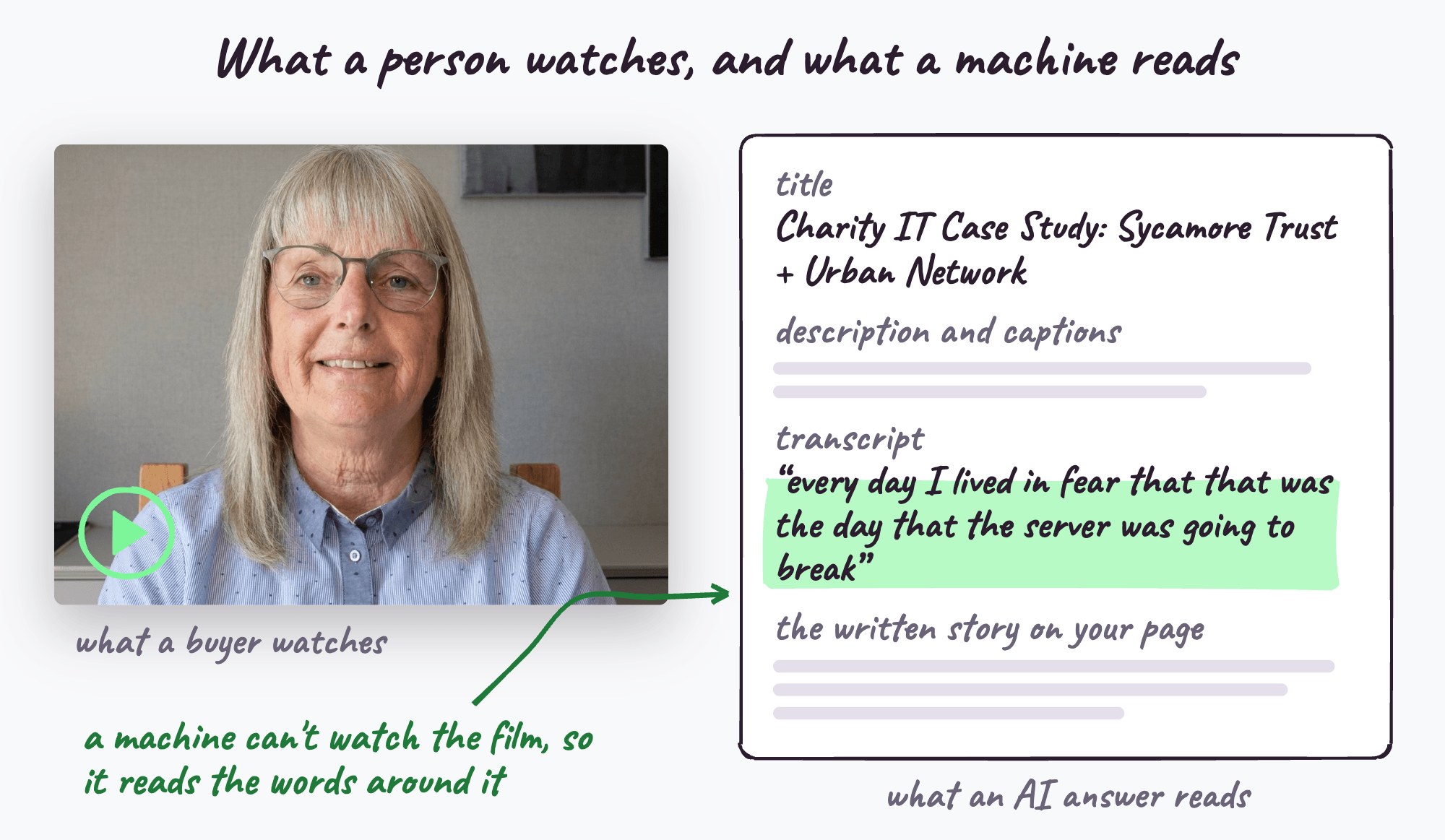
Not as a citation, but it isn't worthless either. An AI answer can't watch your film, so what it picks up is the text around it: the title, the description, the captions and the transcript.
There is an interesting correlation, though. When Ahrefs studied 75,000 brands, the factor most strongly correlated with a brand appearing in AI answers was being mentioned on YouTube, in video titles, descriptions and transcripts, at around 0.737. That's a correlation rather than proof that YouTube causes anything, and it counts mentions across all of YouTube rather than your own uploads. It's still a reason to give every film a proper YouTube page with a full description and a transcript that names you and your customer.
How to publish a customer story so AI search can use it
Four places, and only one of them is your own website.
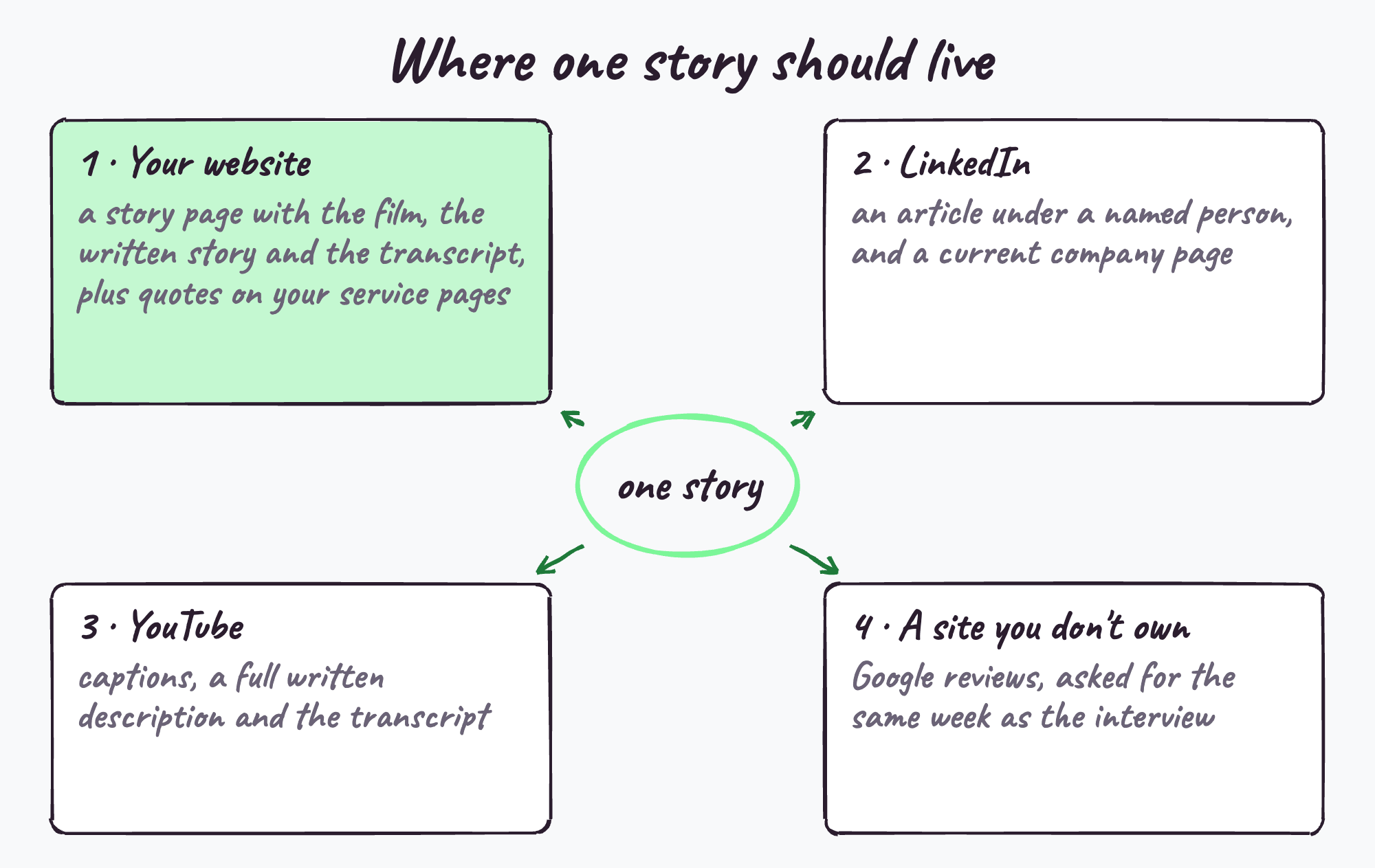
1. Your own website, as text. The story on a page of its own, with the film, the written version and the full transcript in plain HTML. Then the relevant lines on your service pages, with the customer's name, role and company. Pages are what gets cited, and HTML pages made up 99.94% of the file types cited in Promptwatch's data, so a PDF case study on its own is close to invisible.
2. LinkedIn, under a named person. A LinkedIn article carrying the story, published by a real person rather than only by your company page. AI engines treat LinkedIn differently from one another, and Promptwatch's LinkedIn data shows articles, posts and company pages all being cited, so it's also worth keeping your company page's About section current and specific.
3. A YouTube page. The film uploaded with captions, a description that tells the story in words, and chapters. It's the text on that page that gets read.
4. A platform you don't own. Reviews on Google and elsewhere. Google tells its quality raters to check a company's reputation away from its own website, and third-party signals are hard to fake, which is exactly why they're trusted.
Why does specific, named detail matter to AI answers?
Because it's what makes a page the clearest answer. A page that says "we provide responsive managed IT for professional services firms" could be any MSP. A page with a named charity CEO describing how her staff now type up their notes during an appointment rather than after it is identifiably about something.
There's some research on this, with caveats. A 2024 Princeton study on "generative engine optimisation" found that adding quotations to a page increased its share of an AI-generated answer by 41%, and adding statistics by 31% (Aggarwal et al.). But that measured how much of an answer a page earned once it had already been retrieved, not whether it got found in the first place, it used an older model, and a later attempt to replicate the effects found far weaker results. I'd treat it as a sensible direction rather than a formula.
What should you not spend money on?
An llms.txt file. It's a text file some people recommend adding to your site for AI crawlers. In Ahrefs' study of server logs, 97% of valid llms.txt files received no requests at all in the month measured, and Google has said such files neither help nor harm.
Schema promises. Structured data is good housekeeping for search generally, and we include it in every pack for that reason. But when Ahrefs tracked 1,885 pages that added schema, AI citations barely moved. Anyone promising schema will get you into ChatGPT is overselling it.
Markdown copies of your pages. Plain-text duplicates made "for AI" are cited a vanishingly small fraction of the time compared with ordinary HTML pages.
AI visibility scores. Ask the same AI tool the same question twice and you'll often get different sources cited. A single score, or a small movement month to month, tells you very little.
Does this matter for MSPs, or just software vendors?
It matters more for vendors right now. G2's 2026 research found that 51% of B2B software buyers now start their research with an AI chatbot more often than with Google, up from 29% a year earlier.
For MSPs selling to local businesses, traditional search, word of mouth and Google reviews still do most of the work. But the same things help both: specific, named proof on your service pages, published as text. Doing it for human buyers gets you most of the way there for machines as well.
It's also worth knowing that when an AI summary appears, people click through less. Pew Research found users clicked a traditional search result on 8% of visits when a summary appeared, against 15% when it didn't. So the page a buyer does eventually land on needs to convince them fast, which is a job for proof.
Questions people ask
Does ChatGPT cite video testimonials?
Very rarely. In Promptwatch's July 2026 data, video was 0.1% of ChatGPT's citations. It reads the text around a video, such as the title, description and transcript, rather than the video itself.
Do case studies help with AI search?
A case study published as a web page, with specific details, names and quotes in plain text, is the kind of content AI answers can read and cite. A PDF on its own is much harder for them to use.
Should I add an llms.txt file to my website?
There's little reason to. Ahrefs found that 97% of valid llms.txt files received no requests at all in the month they measured, and Google has said the file neither helps nor harms.
Does schema markup get you into AI answers?
The evidence says it makes little difference to AI citations. Ahrefs tracked 1,885 pages adding schema and citations barely moved. It remains useful for ordinary search features.
How can I check whether AI tools mention my business?
Ask them the questions your buyers would ask, such as the best MSP for accountants in your city, and note which sources appear. Repeat it a few times, because answers and citations vary between runs.
Related reading
- Where to put testimonials on your MSP website
- Video testimonial vs written case study vs Google reviews
- How channel vendors use MSP partner stories
Every story we make ships with the written versions, transcripts and web-ready pages that search engines and AI answers can actually read.
See what's in the packJames interviews MSP and tech vendor customers for a living and runs MSP Testimonials, the interview-led testimonial service. If a customer of yours has a story worth telling, this is how it gets told.