Six ways MSP websites hide the proof they already have
Most MSPs have more customer proof than they think. It's just in the wrong place, with the name taken off, or behind a form nobody fills in
 7 min read
Most MSP websites don't lack customer proof, they hide it. The six common ways are naming a customer on the homepage but not where the buyer decides, keeping every story on one testimonials page, gating case studies behind a form, repeating the same three quotes everywhere, building industry and location pages with no customer on them, and losing an acquired brand's stories at consolidation. Each has a simple fix.
When I look at an MSP's website before we start working together, the problem is rarely that they have no proof. They have happy customers who've said lovely things, sometimes on film. They have service pages, industry pages and location pages, some of which rank well. What they almost never have is the two meeting, so a buyer reading the page about their exact problem finds the MSP's own description of itself and nobody else's.
I've come to think production was never the constraint. Knowing what good looks like is, and where the proof should live is the part nobody gets shown.
A note on where this comes from. These patterns are drawn from website audits and page-by-page teardowns we've done for MSPs, films included. I haven't named anyone or put numbers on how common each one is, because the sites we've looked at aren't a statistical sample of the industry, and nobody's website deserves to be turned into a public cautionary tale.
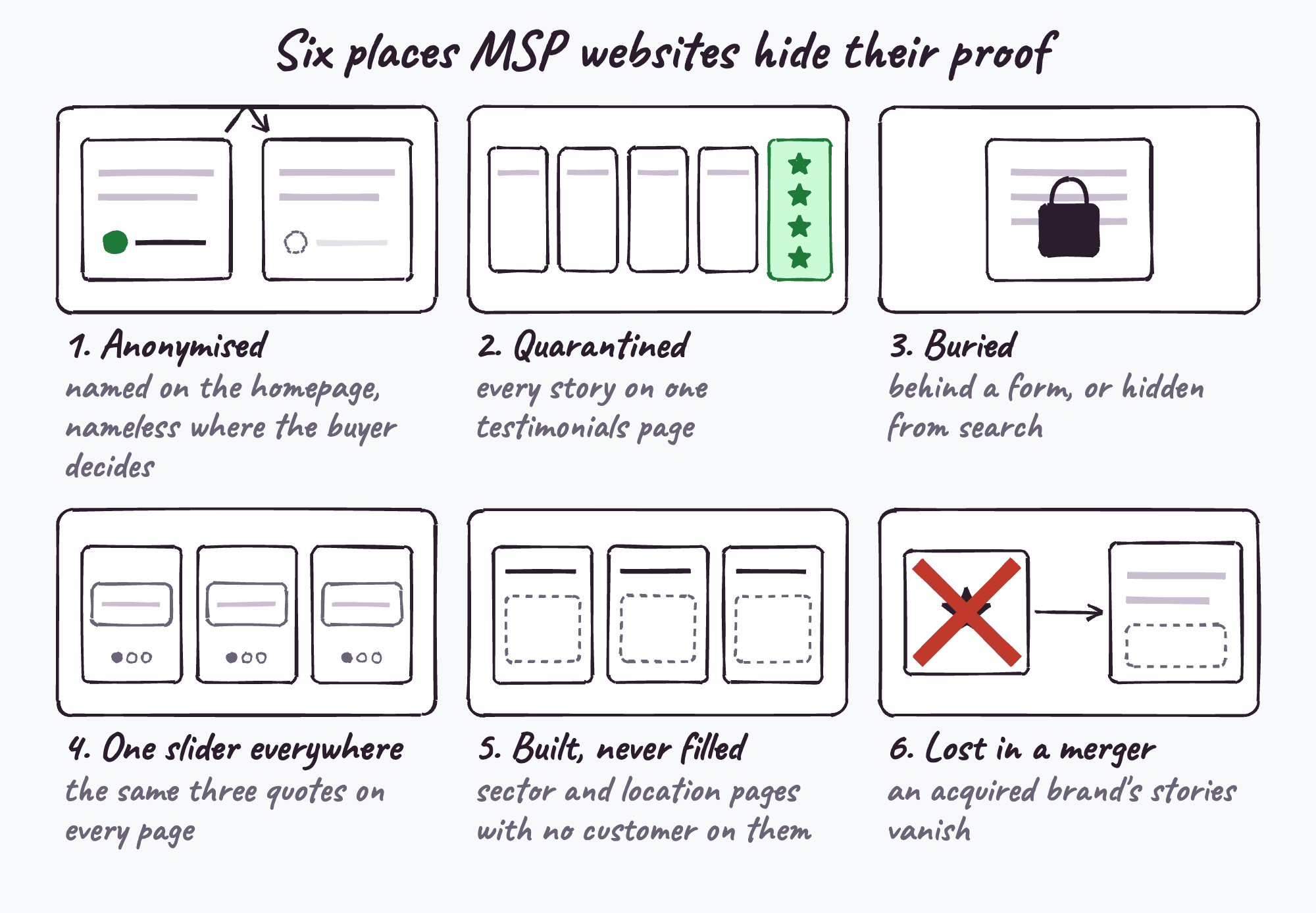
1. The customer is named on the homepage and anonymous where the buyer decides
A full name, job title and company logo on the homepage, then the same story on a service page as "a client in professional services". It usually happens for a sensible-sounding reason: someone worried about confidentiality on the pages that go into more detail, or a template that only has room for a quote.
The effect is that the proof gets weaker exactly where it needs to be strongest. The homepage visitor is browsing. The visitor on your managed security page is deciding.
The fix: treat the quote, the name, the job title and the company as one unit that always travels together. If a customer has agreed to be named anywhere, they've agreed to be named everywhere that story appears, and if they genuinely can't be named, there are better options than anonymous.
2. Every story is quarantined on one page
The testimonials page, or client stories, or case studies. Everything lives there, neatly, and almost nothing lives anywhere else.
A buyer rarely goes looking for that page. By the time someone clicks "testimonials", they've usually already made up their mind about you, one way or the other. The pages they read while they're still deciding are the ones about their problem and their sector.
The fix: keep the page as an archive, and put the relevant line from each story on the service page, the sector page and next to the contact form. There's a full list in where to put testimonials on your MSP website.
3. The best stories are buried behind a form
The detailed case study, the one with the numbers and the before-and-after, sits behind a "download the PDF" form. Sometimes the page is also set not to appear in search.
Gating makes sense for a guide you want to trade for an email address. It makes much less sense for proof, because a buyer who isn't sure about you yet is exactly the person who won't hand over their details to find out. And a PDF behind a form is invisible to Google and to AI search tools, which read pages, not downloads.
The fix: publish every customer story as an ordinary web page, with the film, the written version and the full text visible. Keep a PDF for salespeople to attach, by all means, as a copy rather than the only version.
4. The same three quotes rotate on every page
A slider with three testimonials, installed site-wide, so the cyber security page, the Microsoft 365 page and the careers page all show the same three lines in turn.
Repetition turns evidence into decoration. By the second page the visitor has stopped reading it, and a general quote about great service on a specific service page doesn't answer the question that page is asking.
The fix: one chosen quote per page, matched to that page. A single relevant line from a customer who bought that service does more than any number of rotating ones.
5. The pages were built and never filled
This is the most common pattern I see and the quickest to fix. Industry pages for legal, accountancy, healthcare and construction, and location pages for every town within an hour's drive, written to rank and often ranking well, with nothing on any of them that a customer actually said.
These pages bring in exactly the buyers you want, already filtered by sector or place. Then they meet a page that could have been written about any MSP.
The fix: start with the page that brings in the most visitors and put one relevant customer on it. A law firm on the legal page, a local business on the local page. If you don't have a story for that sector yet, that's the most useful thing to go and get next.
6. An acquired brand's stories disappear
MSPs grow by acquisition, and when a brand is folded in, its website is usually redirected and switched off. Its awards, its accreditations and its customer stories go with it, even though those customers are now yours.
The fix: before an acquired site is switched off, collect every testimonial, case study and review it holds and republish them under the parent brand. And treat an acquisition as a reason to capture new stories, because the acquired customers are often the ones most in need of reassurance that nothing bad is about to happen.
Where proof gets lost between the camera and the page
Even when a business does everything above, proof can quietly lose its strength on its way from the conversation to the website.
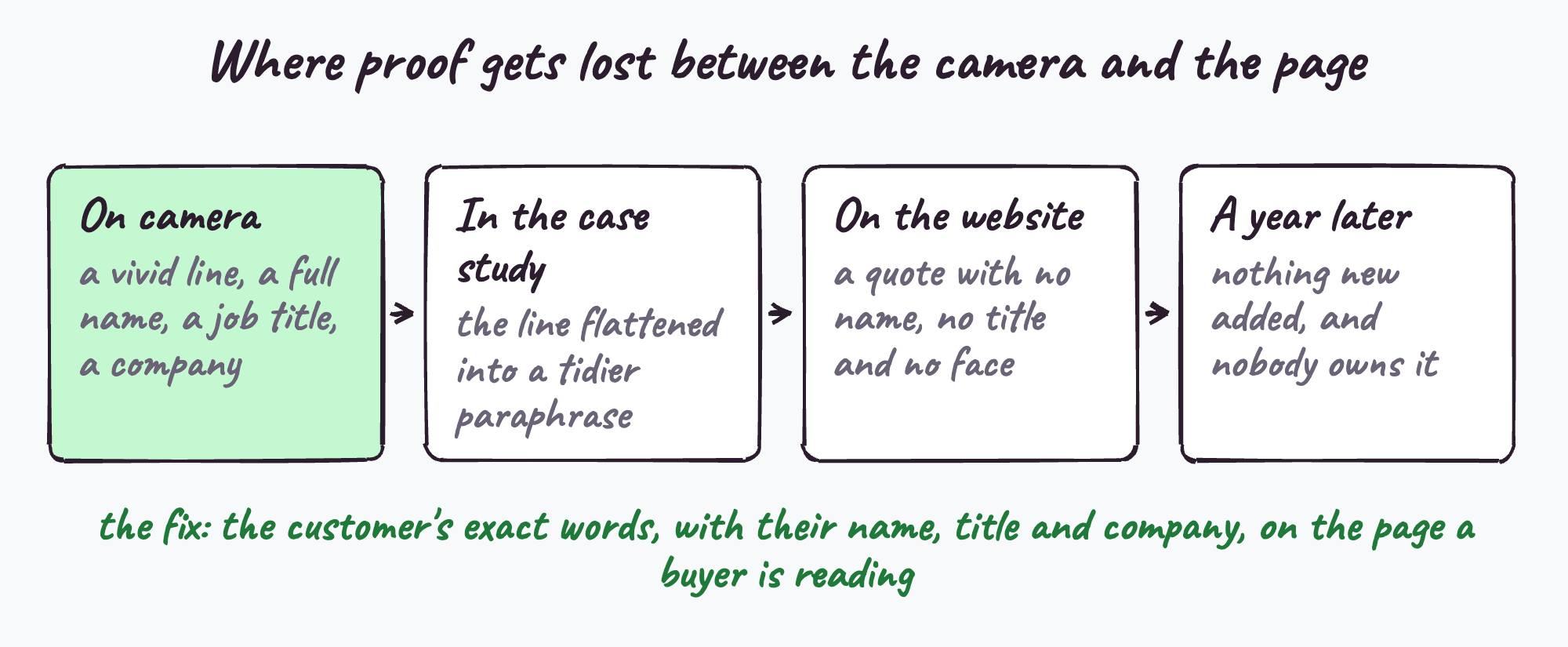
- The line gets tidied. On camera a customer says something vivid and specific, and by the time it reaches the case study it's been rewritten into a smoother sentence that could have come from anyone, still inside quotation marks.
- The job title falls off. The customer states their title in the first few seconds of the film, and the website credits them with none.
- Service pages quote nobody. A real customer's sentence used as a page headline, with no name, company or face attached, which reads exactly like marketing copy.
- Nothing new gets added. A strong run of stories, then nothing for a year or more, which a buyer notices when the newest one mentions a product you've since replaced.
- The best placement happens by accident. The strongest quote on the site sits next to the enquiry form because someone once had a gap to fill, and nobody knows it's the most important quote on the site.
The fix for all of these is the same: the customer's exact words, with their name, title and company, on the page a buyer is reading, and one person who owns keeping it current.
A twenty-minute check you can do today
- Open your three most important service pages. Is there a named customer on each one who bought that service?
- Open your contact page. Is there anything a customer said, right next to the form?
- Pick your best-performing industry or location page. Is there a customer from that industry or place on it?
- Try to read your best case study without filling in a form.
- Find the date of your newest customer story.
- If you've acquired a business, search for one of its old customers' names on your current site.
If you answered no to three or more of those, you almost certainly have more proof than your website is showing.
Is it ever right to keep a customer anonymous?
Yes, when the customer genuinely can't be named: some legal, defence and financial businesses, and anyone in the middle of a sale. But check that someone has actually asked, rather than assuming. And even then, a named person describing an unnamed company, or a sector, size and outcome with a real face on camera, beats an anonymous line of text.
In fairness, our own website has had some of these problems too. It's a lot easier to spot them on somebody else's site than to fix them on your own, which is rather the point of writing them down.
Questions people ask
Should case studies be gated behind a form?
Generally no. A buyer who isn't yet convinced is unlikely to trade their details for proof, and gated PDFs can't be read by search engines or AI tools. Publish the story as a web page and keep the PDF as an extra.
Should the same testimonial appear on every page?
No. Put one quote on each page, chosen to answer that page's question, such as a customer who bought that specific service on the service page.
How often should testimonials on a website be updated?
There's no research-backed rule. As a working habit, add at least one new story a year for each service or sector you care most about, and replace any story that mentions a product or person you no longer work with.
What should an MSP do with an acquired company's testimonials?
Collect them before the acquired website is switched off and republish them under the parent brand, with the customer's permission, so the proof survives the merger.
Related reading
- Where to put testimonials on your MSP website
- Why most MSP testimonials don't work
- Do testimonials help you get found in AI search?
Most of these fixes take an afternoon once you have the stories. If it's the stories you're short of, that's the part we do.
See how it worksJames interviews MSP and tech vendor customers for a living and runs MSP Testimonials, the interview-led testimonial service. If a customer of yours has a story worth telling, this is how it gets told.