Why most MSP testimonials don't work
Five reasons a perfectly nice customer quote wins nobody over, and what the ones that do win business have in common
 7 min read
Most MSP testimonials don't work for five reasons: they are general praise with no specific story, they feature a customer who doesn't look like the prospects the MSP wants, they skip why the customer left their old provider, they sit on a page buyers never visit, and nobody in sales ever sends them. A testimonial that wins business fixes all five.
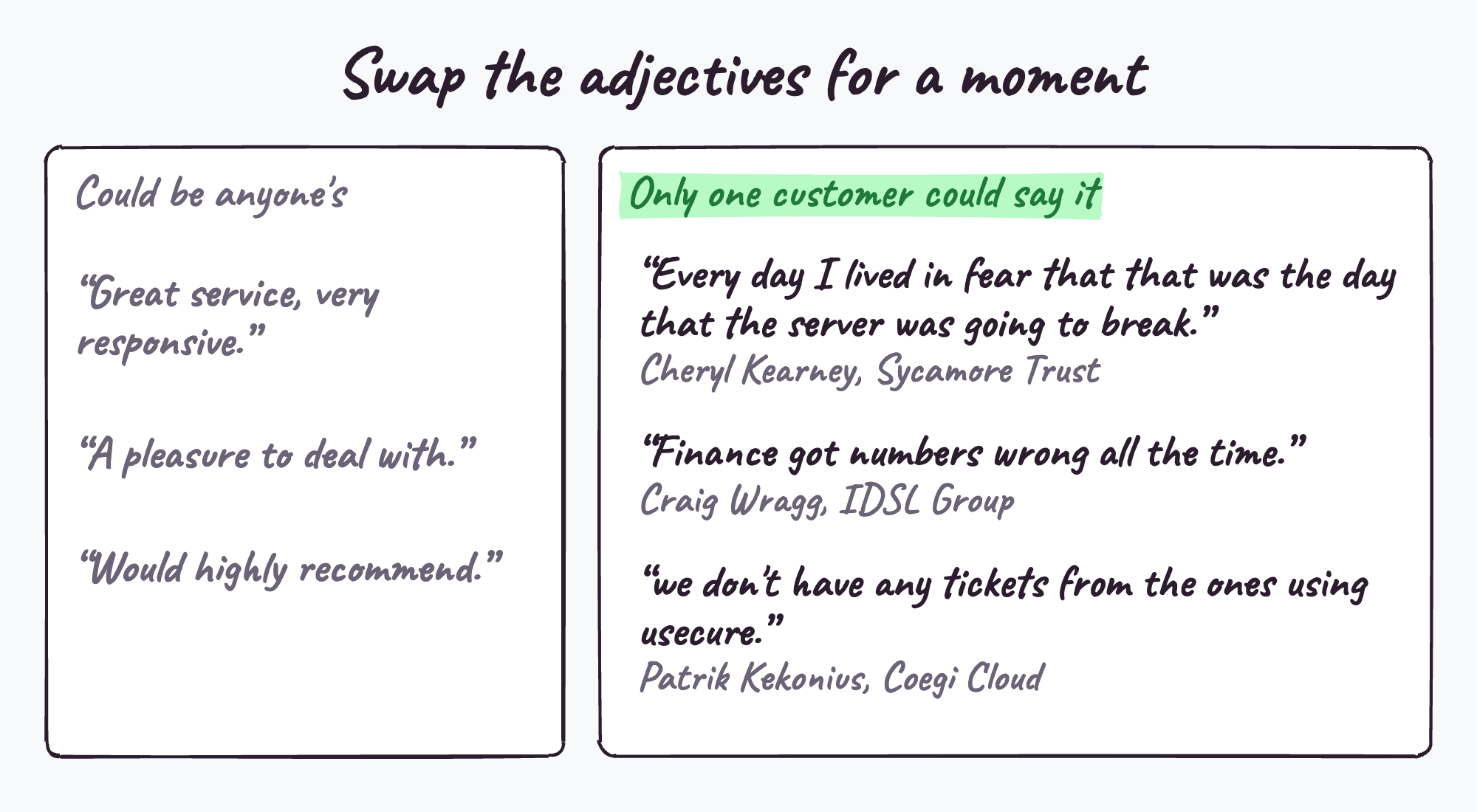
Almost every MSP website has a testimonials page, and most of them say roughly the same thing. "Great service, very responsive, would recommend." Somebody went to the trouble of asking for it, it's true, and it does almost nothing, because a prospect comparing three MSPs will find a sentence very like it on all three sites.
The frustrating part is that the customer who wrote it probably had a genuinely good story, and the testimonial just didn't get it. So here's what goes wrong, in the order I'd look for it.
Reason 1: It's praise, not a story
I call this the Adjective Problem. Responsive, proactive, professional, a pleasure to deal with. Every one of those words is a claim, and a buyer has learned to treat claims from a supplier's website the way they treat the words "limited offer".
What gets past that filter is a specific moment a buyer recognises from their own business. Cheryl Kearney, the CEO of an autism charity in Barking and Dagenham, didn't just tell me her old IT was slow. She told me what it was like running the charity on an office server that had been in place for about ten years:
Every day I lived in fear that that was the day that the server was going to break and we would have no system and we would have no backup.
Any business owner still relying on an old server in the office hears that and feels it in their stomach. That's the job a testimonial is for.
The fix: every testimonial needs at least one real anecdote, meaning something that happened once, to identifiable people, at a time you could point to, where something changed. If there isn't one, the interview didn't find it yet.
Reason 2: The customer doesn't look like the next prospect
A testimonial exists to win more customers like the one in it. So a glowing quote from a household-name retailer does very little for an MSP trying to win accountancy practices, while a modest story from a 30-person practice in the next town does a great deal.
Buyers look for themselves: same sector, similar size, a job title like theirs, a problem they have. A large study of online reviews found that reviewers who disclosed their real name or location were rated as more helpful, and that the effect on sales was stronger when reader and reviewer shared a location (Forman, Ghose and Wiesenfeld, 2008).
The fix: decide who you want more of, then choose whose story to tell. If you can only make one this year, make it with the customer who most resembles the business you most want to win.
Reason 3: It skips the switch
Most MSP buyers already have an IT provider, or someone doing the job. In Kaseya's 2026 State of the MSP report, only 12% of MSPs said their new clients were mostly first-time buyers of managed IT, which means for most MSPs, winning a client involves getting someone to leave an incumbent at least some of the time.
The biggest thing stopping that is fear of the move: the disruption, the staff reaction, the chance that the new lot are no better. A testimonial that starts at "they're great" skips all of it. The story a switcher needs to hear is why this customer left, what they were worried about, and what the move was actually like.
The fix: ask about before, about the last straw, and about the worries, and make sure that part survives the edit. Cheryl's answer on how the move went for her staff, some of whom have autism, so change is a massive thing for them, is worth more to a nervous prospect than anything about uptime:
Everyone was super kind, just really understanding and just worked with everybody at their own pace and appreciated that some people might ask 2000 questions and some people might not ask any.
Reason 4: It's filed where buyers never look
This is the Filing Cabinet Problem, and it's the most common of the five. A testimonial is made, posted to LinkedIn once, uploaded to YouTube, added to a testimonials page, and never touched again.
A buyer rarely goes looking for a testimonials page. They read the pages about the problem they have: your service pages, the page about their sector, and the contact page when they're nearly ready. On most MSP websites those are exactly the pages that carry no proof at all. So a buyer reading about your cyber security service meets your own claims and nobody else's.
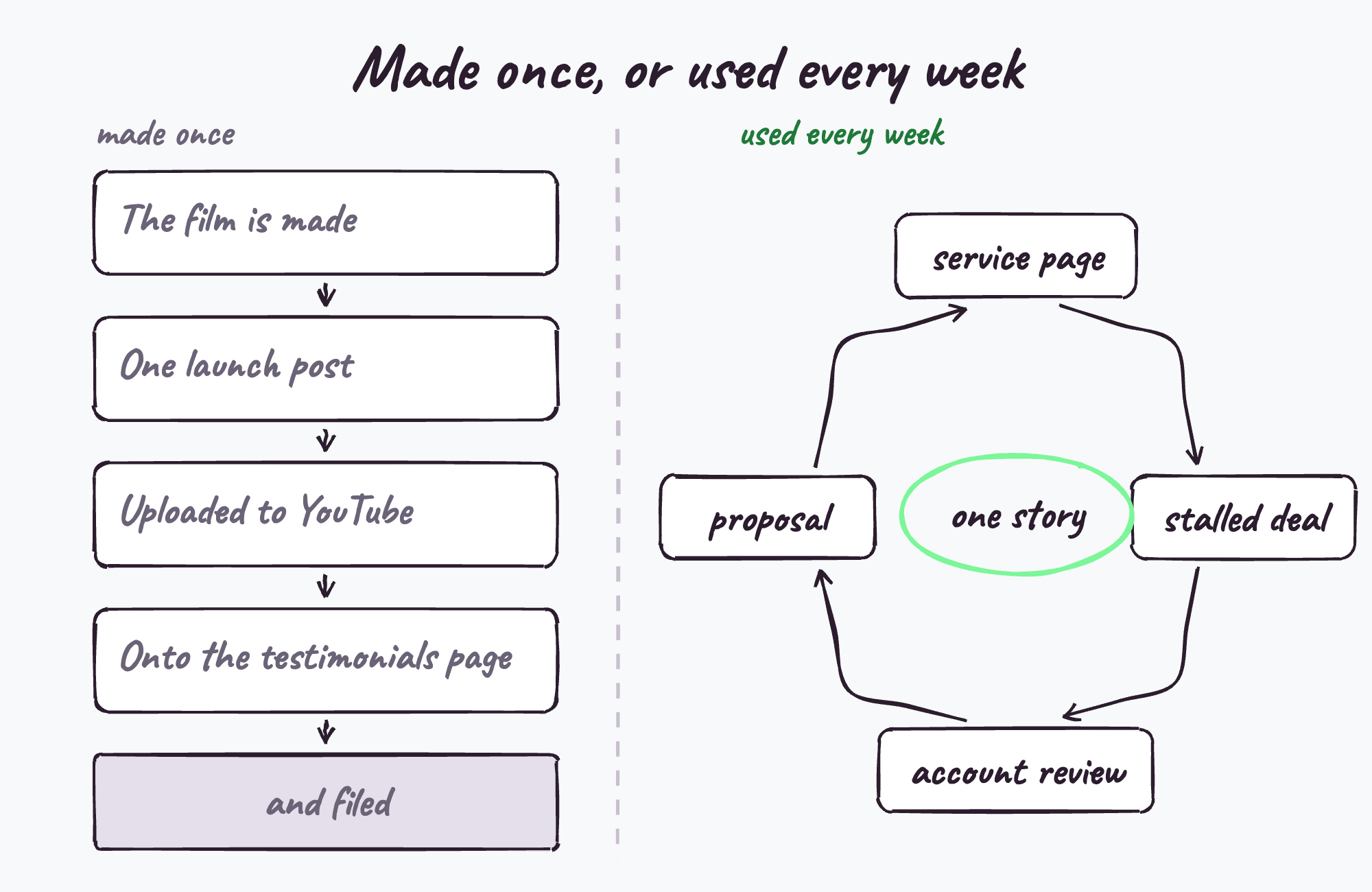
The fix: decide where each piece goes before it's made. The quote about your security service goes on the security page, the verdict goes next to the contact form, and the film goes on the page for the customer's sector. I've gone through the specific places in where to put testimonials on your MSP website.
Reason 5: Nobody in sales ever sends it
Marketing uses a story once. A seller uses it every week, or should do. A testimonial is at its most powerful in a live deal, when a prospect has just raised the exact worry a customer on film has already answered, and most salespeople don't know which clip does that, where to find it or what to write alongside it.
That gap is costing MSPs. The same Kaseya report found the share of MSPs struggling to quickly demonstrate value to clients nearly doubled in a year, from 10% to 19%. A salesperson who can send the right two-minute clip at the right moment is demonstrating value in the most credible way there is, using somebody else's voice.
The fix: give sales something built for them: which clip answers which objection, the best quotes sorted by when to use them, and a couple of lines they can paste into an email. That's why the sales battlecard leads every pack we make. There's more on this in how sales teams use a testimonial every week.
A quick test for your own testimonials
Look at your best testimonial and ask:
- Could the same words appear on a competitor's website without anyone noticing?
- Is the customer the kind of business you want more of?
- Does it say why they left their previous provider, or what worried them about moving?
- Is it on the page a buyer reads before they contact you?
- Could your newest salesperson tell you which prospect to send it to, and when?
If you answered badly on two or more, the testimonial isn't the problem so much as how it was made and where it lives. Both are fixable, and the second costs nothing.
When is a basic testimonial good enough?
For reviews on Google, general praise is fine, because the job there is showing volume and recency rather than telling a story. And a short quote on your homepage from a recognisable local business can do a perfectly good job of saying "real companies use us". The five problems above matter most for the proof you're relying on to win against a competitor, or to persuade somebody to switch.
Questions people ask
What makes a good MSP testimonial?
A named customer who resembles the prospects you want, describing one specific moment from before and after they moved to you, placed on the page a buyer is reading and used by your sales team in live deals.
Why don't customer testimonials increase sales?
Usually because they're too general to persuade anyone, feature the wrong customer, or sit on a testimonials page buyers rarely visit instead of on service pages and in sales emails.
Should an MSP have a testimonials page?
It does no harm, but it shouldn't be where your proof lives. Put the strongest quotes on your service pages, contact page and sector pages, where buyers are making decisions.
Are anonymous testimonials worth using?
Rarely. "A client in financial services" convinces almost nobody. If a customer can't name their company, name the person and describe the business instead.
Related reading
- Testimonial interview questions for MSPs
- Where to put testimonials on your MSP website
- How sales teams use a testimonial every week
Every story we make is built to fix all five: a real scene, the right customer, the switch, placement decided and a battlecard for sales.
See how it worksJames interviews MSP and tech vendor customers for a living and runs MSP Testimonials, the interview-led testimonial service. If a customer of yours has a story worth telling, this is how it gets told.