Should your MSP have video testimonials?
An honest answer for MSP owners. When a customer film earns its cost, when it doesn't yet, and what to do in the meantime
 5 min read
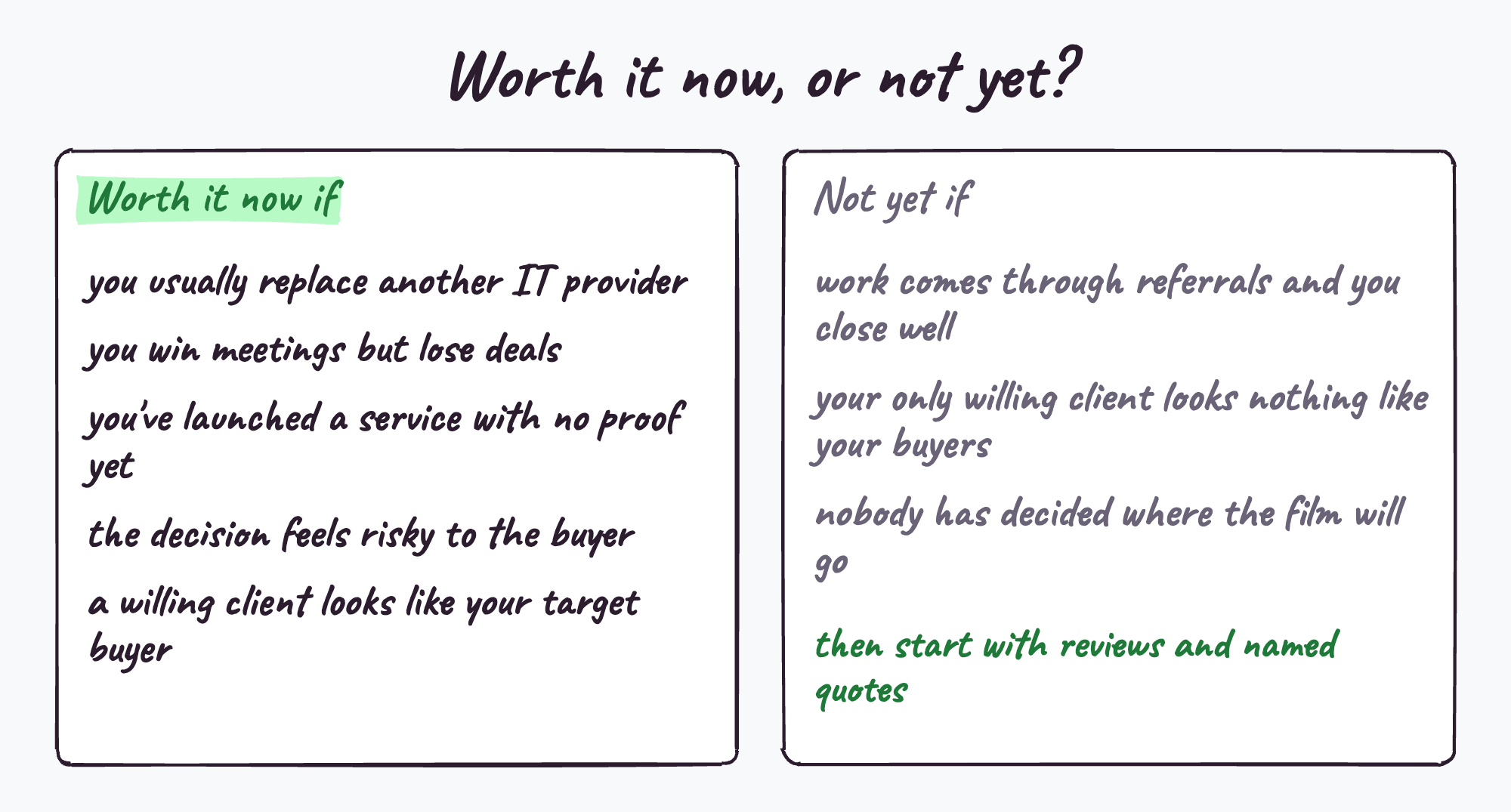
An MSP should invest in video testimonials when it regularly has to persuade buyers to leave an existing IT provider, wins meetings but loses deals, has launched a service it can't yet evidence, or sells security and compliance where the decision feels risky. If most work comes through referrals, buyers are local and close rates are healthy, Google reviews and named written quotes may be enough for now.
I sell customer video testimonials, so you'd expect me to say every MSP needs them. I don't think that's true, and I'd rather you spent your money on the right thing first than bought a film that sits on YouTube doing nothing.
So here's the honest version, based on what the evidence says about how buyers choose and what I've seen work for MSPs.
When a video testimonial is worth it
You usually have to replace someone else
Most MSP buyers already have an IT provider, or someone doing the job. In Kaseya's 2026 State of the MSP report, only 12% of MSPs said their new clients were mostly first-time buyers of managed IT. For almost everyone else, winning work involves getting at least some businesses to leave an incumbent.
That's a hard ask of a buyer who has never worked with you. The research on B2B referrals suggests that when a buyer is considering a supplier they haven't used, an all-positive recommendation carries more weight than a balanced one (Hada, Grewal and Lilien, 2014). In other words, a stranger needs to hear from someone who took the same risk and is glad they did. A named customer on film is the most direct way to put that person in front of them.
You get meetings but lose deals
If the first conversation goes well and the deal still slips away, the problem is usually persuasion rather than awareness. The same Kaseya report found the share of MSPs struggling to quickly demonstrate value to clients nearly doubled in a year, from 10% to 19%. A customer describing what changed, in their own words, demonstrates value in a way your own slides can't.
You've launched something nobody has seen you deliver
A new service line has no proof by definition, and right now that mostly means AI. Kaseya's report found 48% of MSPs named AI and automation as their clients' top need for 2026, while only 13% named AI as a meaningful source of revenue. That gap is a proof gap as much as anything: buyers want it, and they want to see someone like them who has already done it with you.
Your buyers are making a risky decision
Security, compliance, a migration, an office move. When the downside of getting it wrong is personal for the person deciding, a real customer's account of how it went does more than a feature list.
You have a customer who looks like the buyers you want
This one is a precondition as much as a reason. A story only works if a prospect watches it and thinks "that's us". If you've got a willing customer in the sector and size you most want to win, that's the moment to act. If you haven't yet, that shapes what to do first.
When it isn't worth it yet
Your work comes through referrals, your buyers are local and your close rate is healthy. A human being is already vouching for you in every deal, and that's the most powerful proof there is. A Harvard study of restaurants in Washington State found an extra star on Yelp lifted revenue by 5 to 9% for independent restaurants while chains barely benefited (Luca, Harvard Business School). It's a different industry, but the lesson travels: for a smaller local business, reviews from real customers carry a lot of weight on their own.
Your only willing customer looks nothing like your target buyers. A story from the wrong kind of business can tell a prospect you don't really work with companies like theirs. Wait for the right customer rather than making a film for the sake of it.
You have nowhere to put it. If there's no decision about which page it goes on, who sends it and when, a film sits wherever it was uploaded. Sort out where proof will live first. Where to put testimonials on your MSP website covers that.
What to do in the meantime
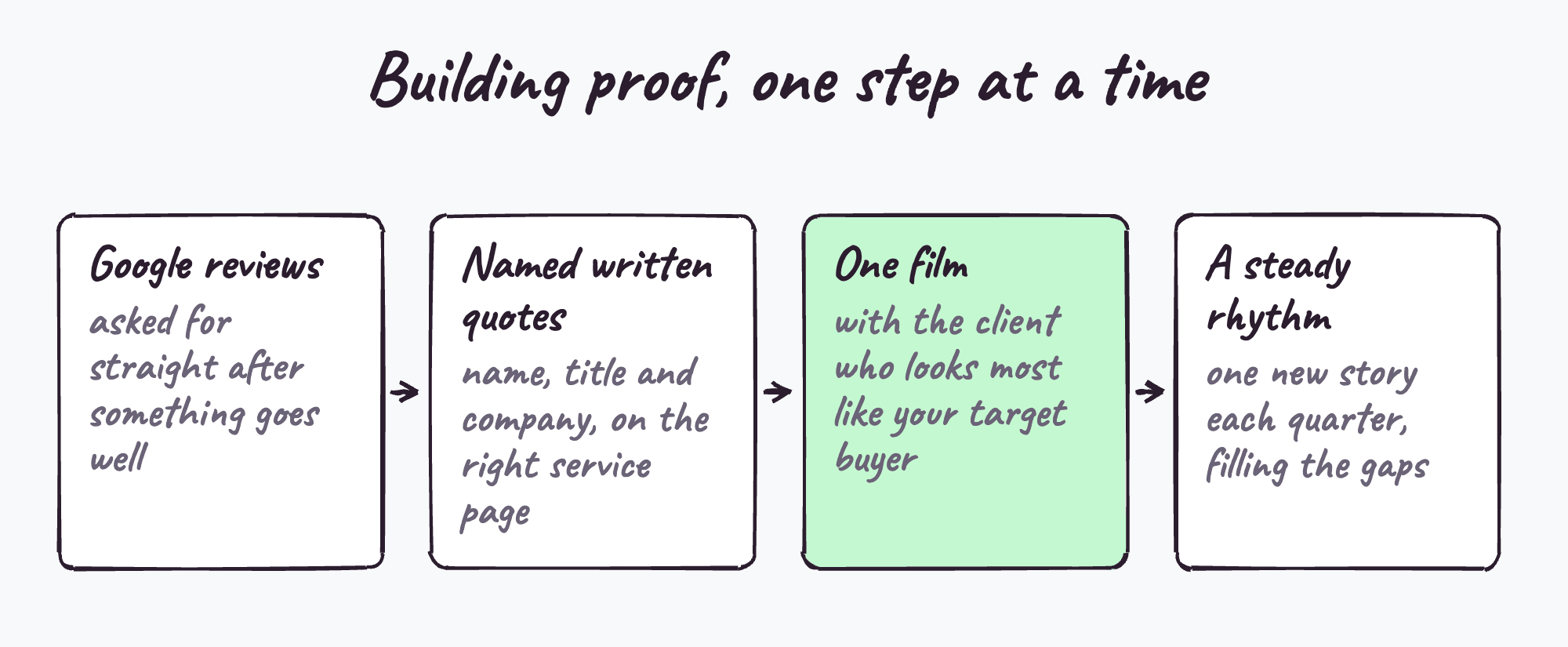
Get Google reviews, steadily. Ask straight after something goes well, such as a tricky ticket resolved or a project delivered, and never offer anything in return for a public review.
Collect named written quotes. A short quote with the person's name, job title and company, placed on the service page it relates to. A study of UK small and medium-sized businesses buying services found they preferred more detailed written references, and that a bare wall of logos only worked alongside a word-of-mouth recommendation (Tóth, Nieroda and Koles, 2020).
Record one yourself if you have a confident customer. Use a decent phone, ask for a specific story rather than general praise, and put the result on the right page. The questions I use are in testimonial interview questions for MSPs.
Pick your first film customer carefully. When you do make one, start with the customer who most resembles the business you most want to win. More on that in which client should you ask for a testimonial?
How much does it cost?
Anything from free, if you do it yourself, to several thousand pounds with a film crew. A remote interview with the full sales and marketing pack costs $2,295 a story with us. There's a full breakdown of the options in how much does a video testimonial cost?
Questions people ask
Do small MSPs need video testimonials?
Not always. If most of your work comes through referrals and your close rate is healthy, Google reviews and named written quotes may be enough. A video earns its cost when you regularly compete to replace another provider or struggle to turn meetings into signed deals.
Are video testimonials worth it for an MSP?
They're worth it when they answer a specific problem: persuading buyers to switch provider, proving a new service, or reassuring someone making a risky decision. They're much less useful if there's no plan for where the film will be used.
Can an MSP record its own video testimonials?
Yes. A good phone, a confident customer and questions that ask for a specific story will get you a usable film. What's harder to do yourself is getting the customer to be candid with their own supplier.
How many video testimonials does an MSP need to start?
One good one, from a customer who looks like the buyers you most want, placed on the right page and used by whoever sells. Add more as you find customers who fill other gaps.
Related reading
- Video testimonial vs written case study vs Google reviews
- Why most MSP testimonials don't work
- Which client should you ask for a testimonial?
If you're at the point where a customer film would earn its keep, we do the asking, the interview and the whole pack in 14 working days.
See how it worksJames interviews MSP and tech vendor customers for a living and runs MSP Testimonials, the interview-led testimonial service. If a customer of yours has a story worth telling, this is how it gets told.