Which client should you ask for a testimonial?
Most MSPs ask their friendliest client or their biggest name. Here's how to pick the one whose story will win you the next deal
 5 min read
Ask the client who most resembles the customers you want more of, rather than your biggest name or friendliest contact. A good testimonial client is happy without being prompted, has been with you long enough to describe before and after, can say what changed, is comfortable talking, and has a specific moment or result to point to. Decide who the story is for first, then choose who tells it.
The usual way an MSP picks a testimonial client goes something like this. Someone asks "who loves us?", three names come up, the first one to say yes gets the film, and nobody asks whether that client's story will persuade anyone. It's a popularity contest, and it produces nice films that don't win deals.
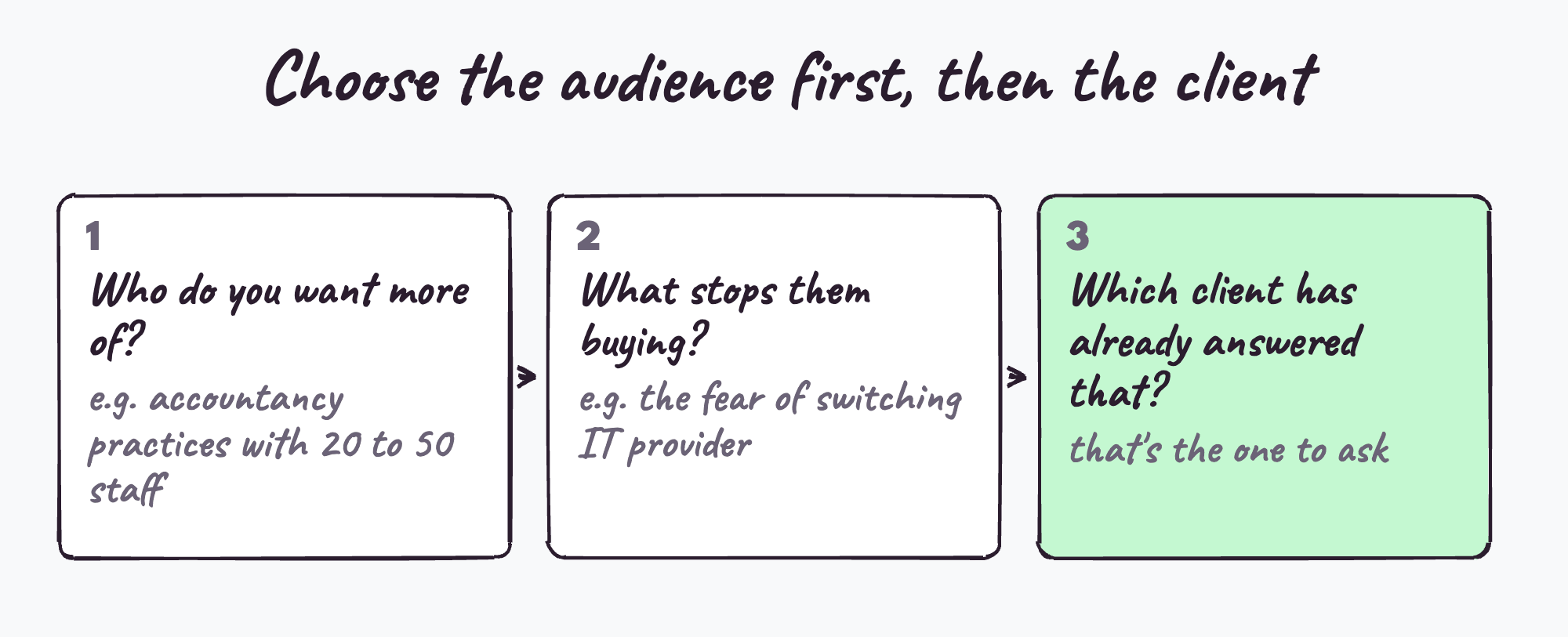
The better order runs the other way round: start from the buyer you're trying to win, work out what's stopping them, and then find the client who has already answered that.
Start with who the story is for
Who do you want more of? Be specific: a sector, a size, a job title. "Accountancy practices with 20 to 50 staff in the North West" is a useful answer. "SMEs" isn't.
What stops them buying from you? Usually it's the fear of switching, doubt that you understand their sector, or a question about whether you can handle a business their size.
Which client has already answered that? Now you're looking for a person. The right client is one who looks like the buyer you want, and whose story speaks to the thing that's stopping that buyer.
A testimonial exists to help a prospect watch it and think "that's us". Every choice about who to ask should go through that test.
Six signs of a good first interview
Once you have a few candidates, score them. You want someone who ticks at least four of these.
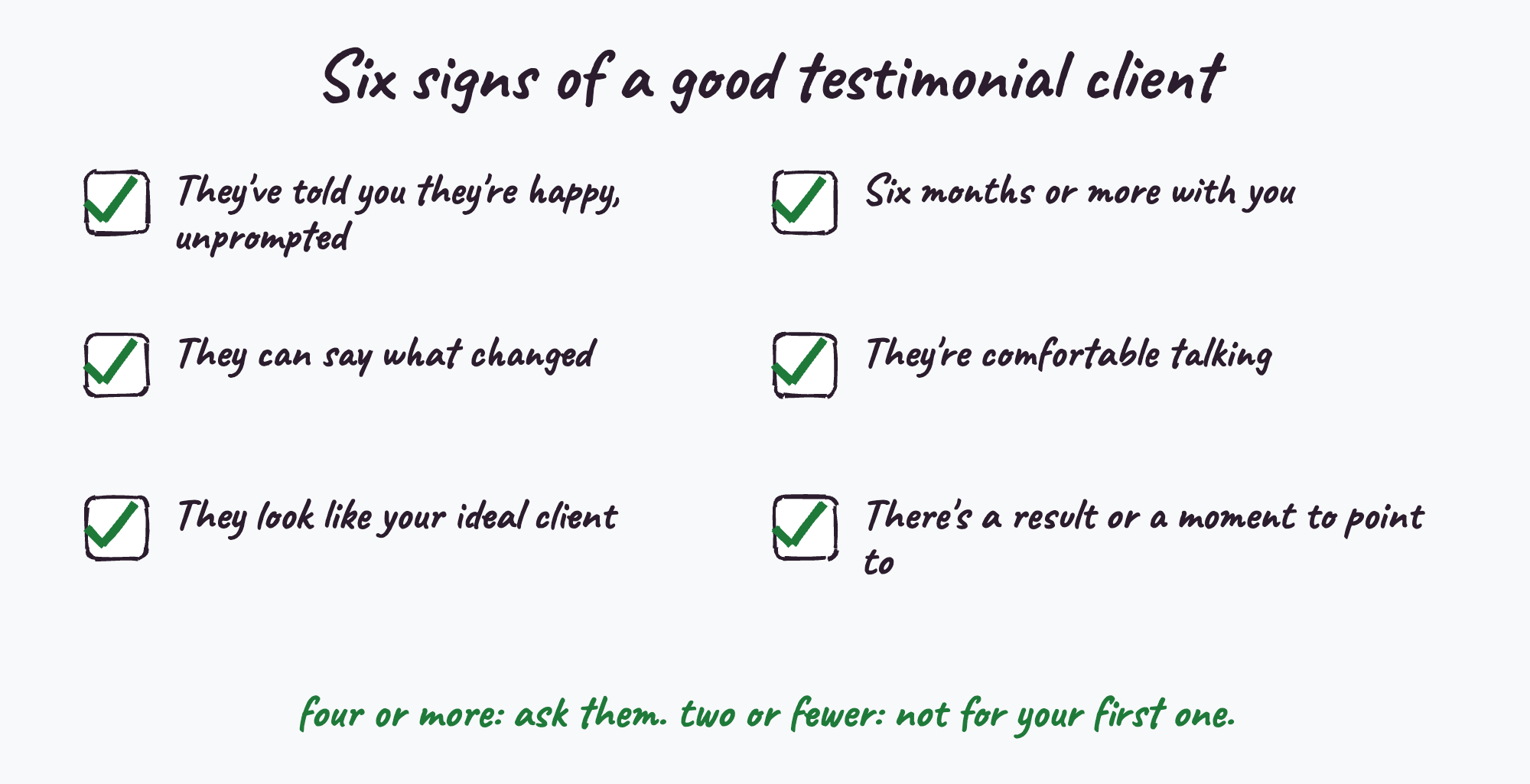
- They've told you they're happy without being asked. Unsolicited praise is the strongest signal there is, and it gives you the opening line of the ask.
- They've been with you for six months or more. Long enough for something to have changed and for them to describe both the before and the after.
- They can say what changed. Some clients are delighted and can't tell you why. Lovely people, hard interview.
- They're comfortable talking. They don't need to be polished, just willing to say a real sentence about a real thing.
- They look like your ideal client. Sector, size and shape of problem.
- There's a result or a moment to point to. A number, even a rough one, or a specific day when something happened.
If someone scores two out of six, don't start with them. Get one good story done with a five-out-of-six client first, then work down the list.
The picks that fall flat
The biggest logo. A glowing story from a household name does less than you'd think for an MSP trying to win 30-person businesses, because those buyers don't see themselves in it. A modest story from a business just like theirs does far more.
The friendliest contact. The client you get on best with is often the one who'll say lovely things and nothing specific. Warmth is a good sign; it isn't enough on its own.
The longest-standing client, for a switching story. A client who moved to you five years ago often can't remember the switch in any detail. They can tell a different and valuable story, about what it's like when things change, staff come and go or the business grows. Ask them for that story instead, and ask a newer client about the move.
The hardest one first. A client in a sensitive sector who needs three sign-offs is a fine story eventually. As a first attempt it's how people conclude testimonials are too much trouble.
Choose the story as well as the person
There are two kinds of story worth telling, and they're for different audiences.
The switching story is for prospects: why they left their old provider, what they were worried about and what the move was actually like.
The expansion story is for your existing clients: why someone who already worked with you added a second service. It answers a different doubt, which isn't "are they any good?" but "are they any good at this as well?"
The quickest way to find an expansion story is to ask your account managers one question: who bought a second thing from us, and when?
Look for the person who took the risk
Inside a client business, the best person to interview is usually whoever chose you in the first place. They took a risk on you, they remember what things were like before, and they have a stake in the decision having been the right one.
Cheryl Kearney is a good example. She's the CEO of Sycamore Trust, an autism charity in Barking and Dagenham, so she's both the person who made the case for new IT to her trustees and one of the people who relies on it every day. She also knew exactly what was riding on it:
At the time I knew it would probably be the biggest financial decision that I would make as CEO.
She had a clear before (an office server that had been in place for about ten years), a decision she took to her trustees herself, and a specific worry she can name. That's close to six out of six.
What if the right client can't be named?
Check that someone has actually asked, because "we can't be named" is often an assumption. If it's genuine, go down the ladder: name the person and describe the company, or name the sector, size and outcome with a real person on camera. Even that beats an anonymous quote. I've gone through it in what if my client says no to a testimonial?
Questions people ask
Who is the best client to ask for a testimonial?
The client who most resembles the customers you want to win, who has told you they're happy, has been with you long enough to describe before and after, can explain what changed, and has a specific moment or result to talk about.
How long should a client have been with you before you ask for a testimonial?
Around six months or more, so there's a real before and after. A newer client is better for a story about switching to you; a long-standing client is better for a story about consistency and change over time.
Should you ask your biggest client for a testimonial?
Only if they resemble the businesses you want to win. A famous name that doesn't look like your target buyers usually persuades less than a smaller client who does.
Who inside the client business should give the testimonial?
Usually the person who chose you, because they remember what things were like before and took the decision themselves. The person who signs off the spend is often the most persuasive voice for other buyers.
Related reading
- Turn your helpdesk into a testimonial engine
- Why most MSP testimonials don't work
- Testimonial interview questions for MSPs
Pick the client and make the introduction. We do the asking, the interview and the whole pack.
See how it worksJames interviews MSP and tech vendor customers for a living and runs MSP Testimonials, the interview-led testimonial service. If a customer of yours has a story worth telling, this is how it gets told.