How many testimonials does your business need?
There's no magic number, and anyone who gives you one is guessing. There is a sensible way to work out yours, and it starts with your own website menu
 6 min read
There is no research-backed number of testimonials a business needs. A better way to decide is coverage: one customer story for each service in your website's main menu, one for each sector you most want to win, a switching story for prospects, an expansion story for existing clients, and one for any new service. Because one story usually covers two or three services, most MSPs need fewer stories than that list suggests.
I get asked this a lot, usually in the form "how many should we start with?", and I understand why. A number is something you can budget for and tick off. The honest answer is that nobody has studied how many testimonials a business needs, and any figure you read without a method behind it is somebody's guess.
What I can give you is a method, and it's more useful than a number anyway, because it tells you which stories to go and get rather than how many to collect. The idea is simple: a buyer arrives at your website with a specific problem and a specific kind of business. The question isn't how many testimonials you have. It's whether that buyer finds one that matches them.
Count coverage, not testimonials
Ten testimonials from ten accountancy practices about your helpdesk is a lot of testimonials and very little coverage. A law firm looking at your cyber security service still finds nobody like them.
Three testimonials, from a law firm about security, a manufacturer about moving to the cloud and a charity about switching from their old provider, is fewer testimonials and far more coverage.
So work out your number from the gaps you need to fill.
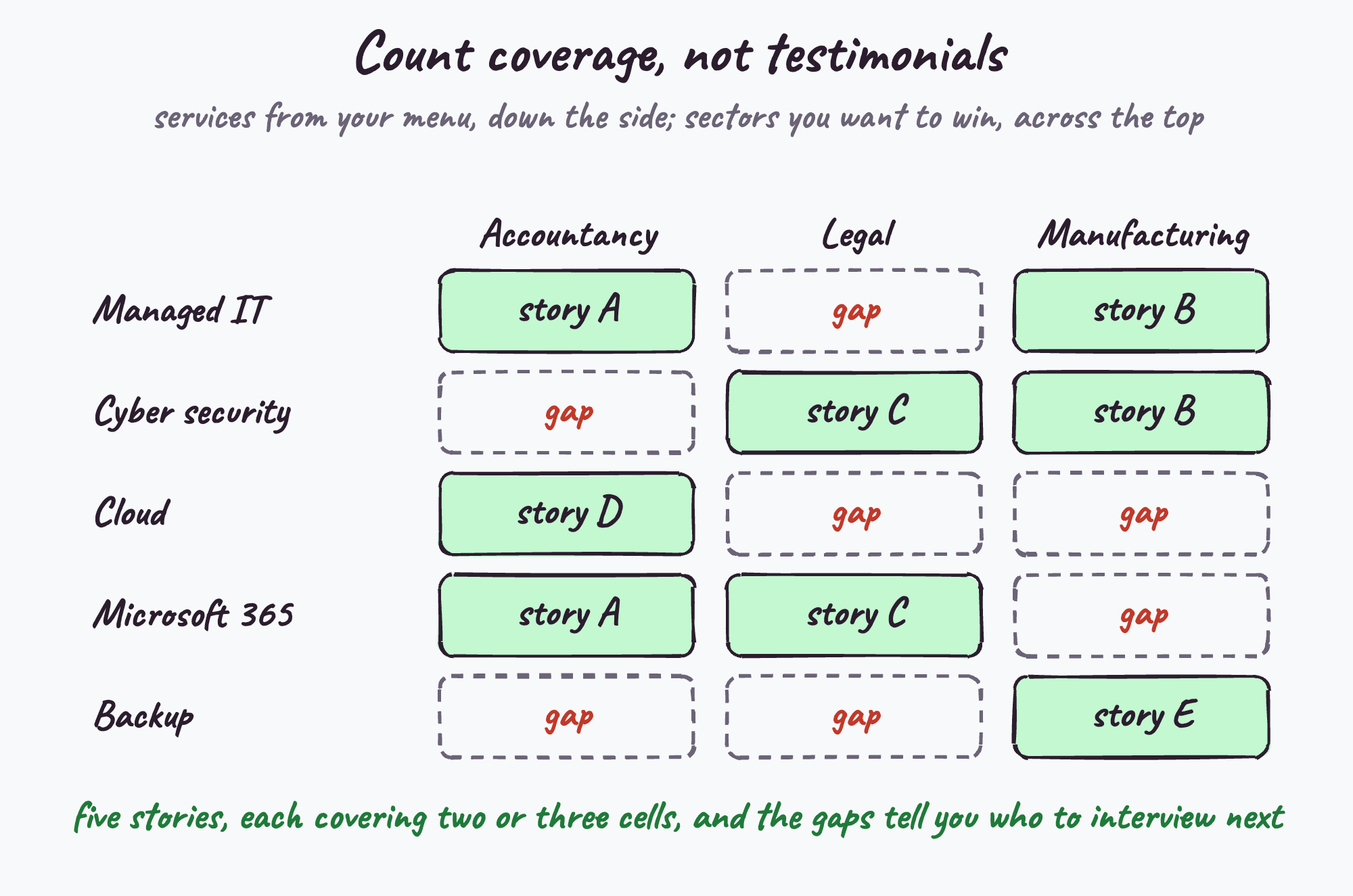
Step 1: One story for each service in your menu
Open your website and look at the top-level menu. Each service listed there is a page a buyer reads while deciding, and each of those pages needs a customer who bought that service. If it isn't in your menu, it doesn't need its own story yet.
The good news is that one interview rarely covers only one service. A customer who moved to you for managed IT usually talks about the helpdesk, the security work and the cloud migration in the same conversation. When we make a story, the five short clips include up to three about individual services the customer bought, each one ready for its service page.
Step 2: One story for each sector you want to win
Buyers look for a business like theirs, so the sectors you most want more of each need a customer who belongs to them. Keep the list short: the two to four sectors that make up the business you're actually chasing, rather than every sector you've ever had a client in.
A sector story doesn't have to be a separate interview. The law firm talking about security covers a service and a sector at once.
Step 3: A switching story, and an expansion story
These answer two different doubts.
A switching story is for prospects who already have an IT provider: why the customer left, what they were worried about, and how the move went. Most MSP buyers are in that position. In Kaseya's 2026 State of the MSP report, only 12% of MSPs said their new clients were mostly first-time buyers of managed IT.
An expansion story is for your existing clients: why somebody who already worked with you added a second service. It's the story most MSPs don't have, because almost every testimonial ever made is a switching story.
Step 4: One for anything new
A service you've just launched has no proof by definition, and it's usually the thing you most need to sell. Right now, for a lot of MSPs, that's AI. Put a new service at the front of the queue.
A worked example
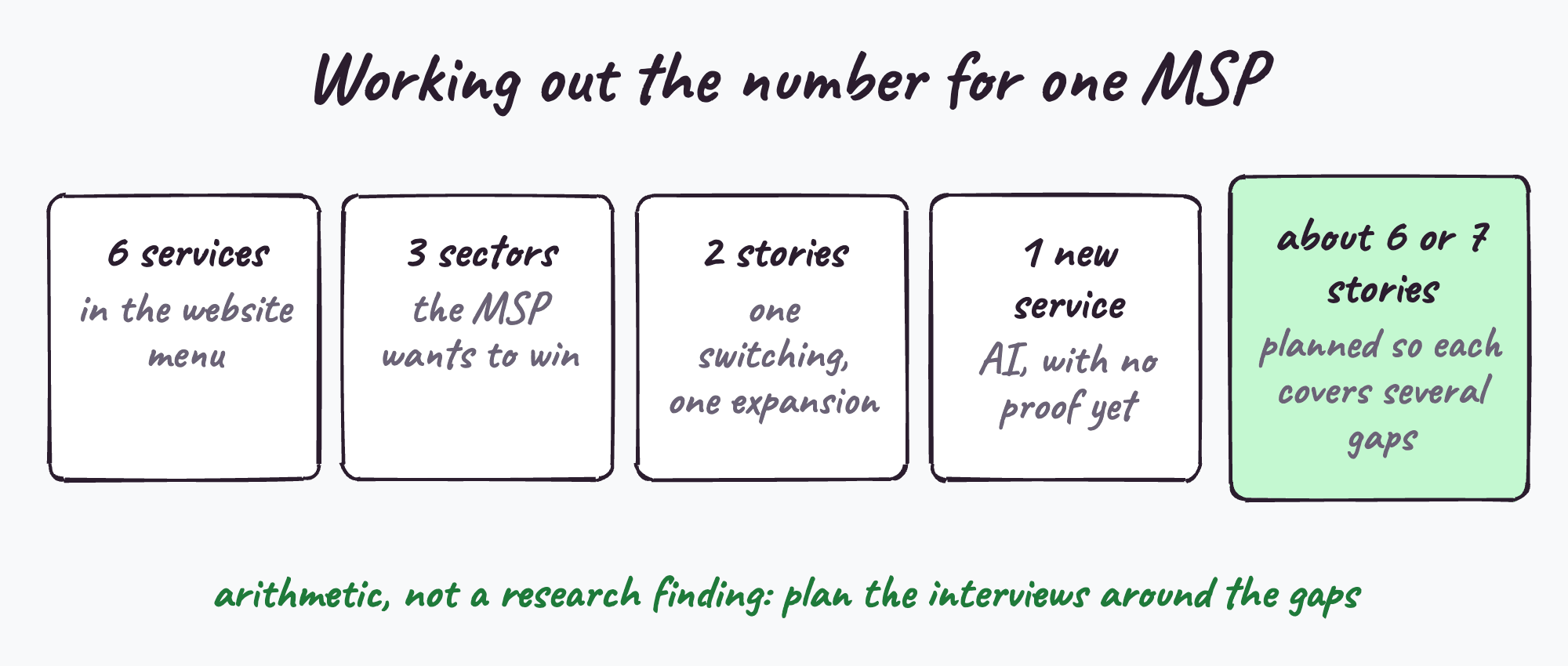
Take an MSP with six services in its menu (managed IT, cyber security, cloud, Microsoft 365, backup, and communications) that wants to win more accountancy practices, law firms and manufacturers.
On paper that's six services, three sectors, a switching story, an expansion story and a new AI service. But stories overlap. An accountancy practice that switched to you and talks about managed IT and backup covers one sector, two services and the switching story in one go. Plan the interviews to fill different gaps, and that MSP could reasonably cover the lot with six or seven well-chosen stories.
That's arithmetic, not a finding. The point is that you plan who to interview around the gaps, rather than collecting stories from whoever says yes first.
Then keep adding, steadily
Coverage isn't a one-off job. Services change names, you launch new ones, you acquire a business, and a story from four years ago starts mentioning a product you no longer sell. There's no research-backed rule for how often to refresh, but a steady rhythm, such as one new story a quarter chosen to fill the biggest gap, keeps the library current without turning it into a project.
How many is too many?
It's hard to have too many stories, and easy to have too many in the wrong place. The big software companies run libraries of hundreds, and they only work because they're organised so a buyer can find the right one in seconds. Once you're past a handful, the question shifts from how many to how they're organised, which I've covered in how to organise testimonials on your website.
What about Google reviews?
Reviews are a different job, and there's no sensible target number for those either. What matters there is a steady flow of recent reviews from real clients, asked for straight after something goes well. Reviews tell a buyer you're safe to consider; stories persuade them to choose you. There's more on the difference in video testimonial vs written case study vs Google reviews.
Which of our packs fits which situation?
If you're working with us, the packs map roughly onto the method above. A Single is a sensible way to start with your best-fit customer. A 3-Pack typically covers your most important services and your switching story. A 6-Pack covers services and priority sectors. The 12 and 24 packs are built for multi-brand groups and vendors covering several partner types, and every pack releases one story a month so the rhythm is built in. Prices are on the page.
Questions people ask
How many testimonials should a small business have?
There's no research-backed number. Aim for coverage instead: a customer story for each of your main services and priority sectors, which for many small businesses means a handful of well-chosen stories rather than a long list.
How many testimonials should be on one page?
Usually one, chosen for that page: a customer who bought that service on a service page, or a customer from that sector on a sector page.
How often should you add new testimonials?
A steady rhythm works better than a big push. One new story a quarter, chosen to fill your biggest gap, keeps your proof current without becoming a project.
Does every testimonial need to be a video?
No. A mix of films, named written quotes and Google reviews covers different jobs. A film earns its place on the pages and in the deals where persuasion matters most.
Related reading
- How to organise testimonials on your website
- Which client should you ask for a testimonial?
- Where to put testimonials on your MSP website
Tell us which services and sectors you want to win, and we'll help you pick the customers who cover them.
See the pricingJames interviews MSP and tech vendor customers for a living and runs MSP Testimonials, the interview-led testimonial service. If a customer of yours has a story worth telling, this is how it gets told.