How channel vendors use MSP partner stories
For vendor marketing and channel leaders. Why an MSP needs different proof from a direct buyer, what a partner story should show, and where it earns its keep
 6 min read
Channel vendors use MSP partner stories to recruit new partners and to help existing partners sell. The strongest ones show the MSP's own business outcome, such as tickets removed, engineer time saved or a service that sells, told by a named partner. They are packaged twice: once for the vendor's channel team, and once for partners to use with their own customers.
If you market a product that MSPs resell, or that MSPs buy and use to run their clients, you already know your proof problem is different from a direct seller's. You're rarely in the room when the decision gets made. Your partners sell you when you're not there, to clients you'll never meet, and the sales force doing it doesn't work for you.
That changes what a customer story has to do, and it changes who needs to be in it.
Why do MSPs need different proof from a direct buyer?
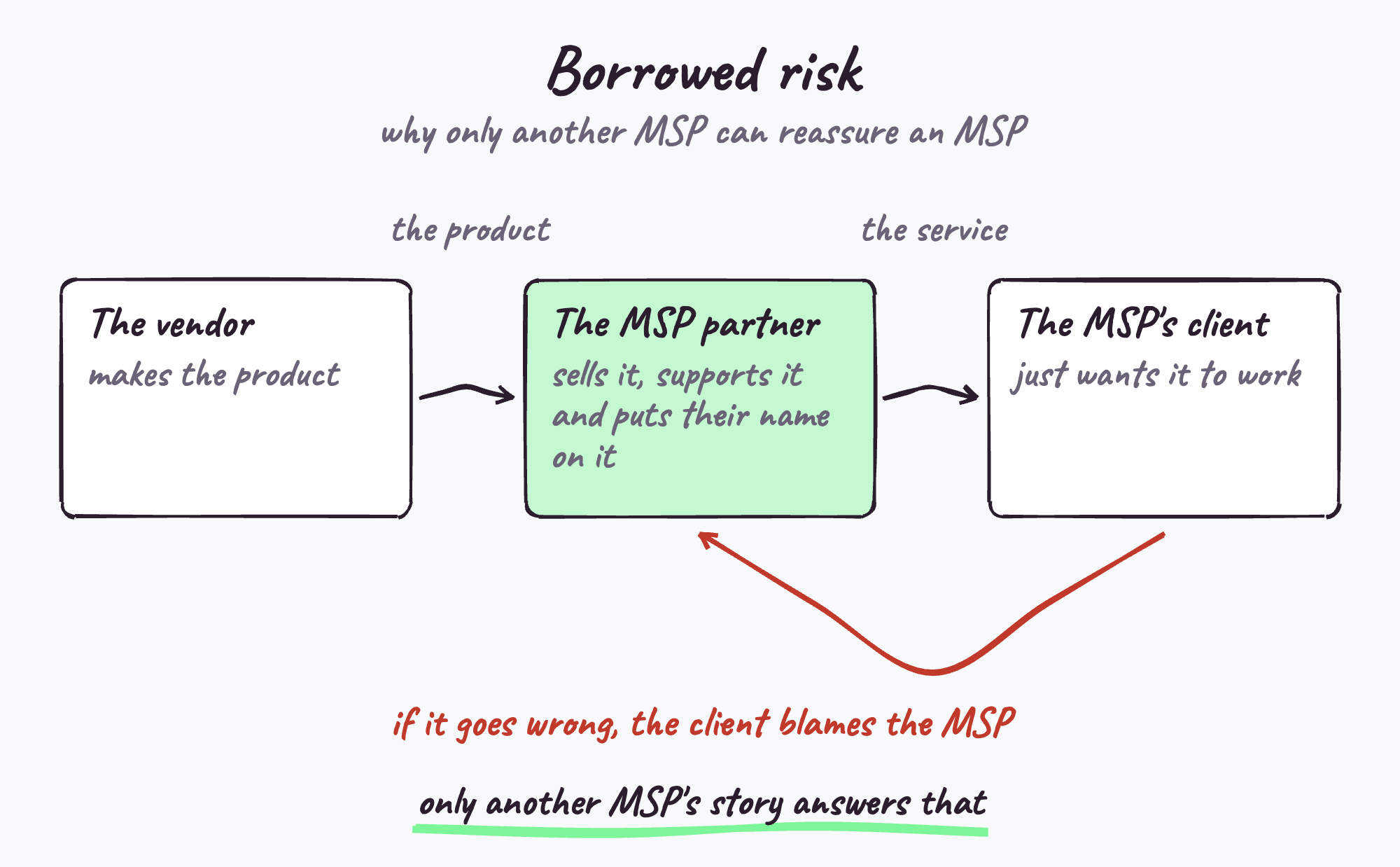
Because an MSP taking on your product is taking on a risk that isn't really theirs to begin with. They're asked to train their engineers, carry the support, build it into their packages and put it in front of clients they've spent years winning. If it goes wrong, their client doesn't blame you. They blame the MSP.
I think of that as borrowed risk, and your own marketing can't answer it, because you're the party they're borrowing it from. The only credible answer is another MSP who took the same risk and can describe what happened.
What should an MSP partner story show?
The MSP's business, not only your features. An MSP doesn't buy good software for its own sake. It buys margin, recurring revenue, fewer tickets, engineers freed up for billable work, and a service it can sell. The story should put those in front of the viewer in the partner's own words.
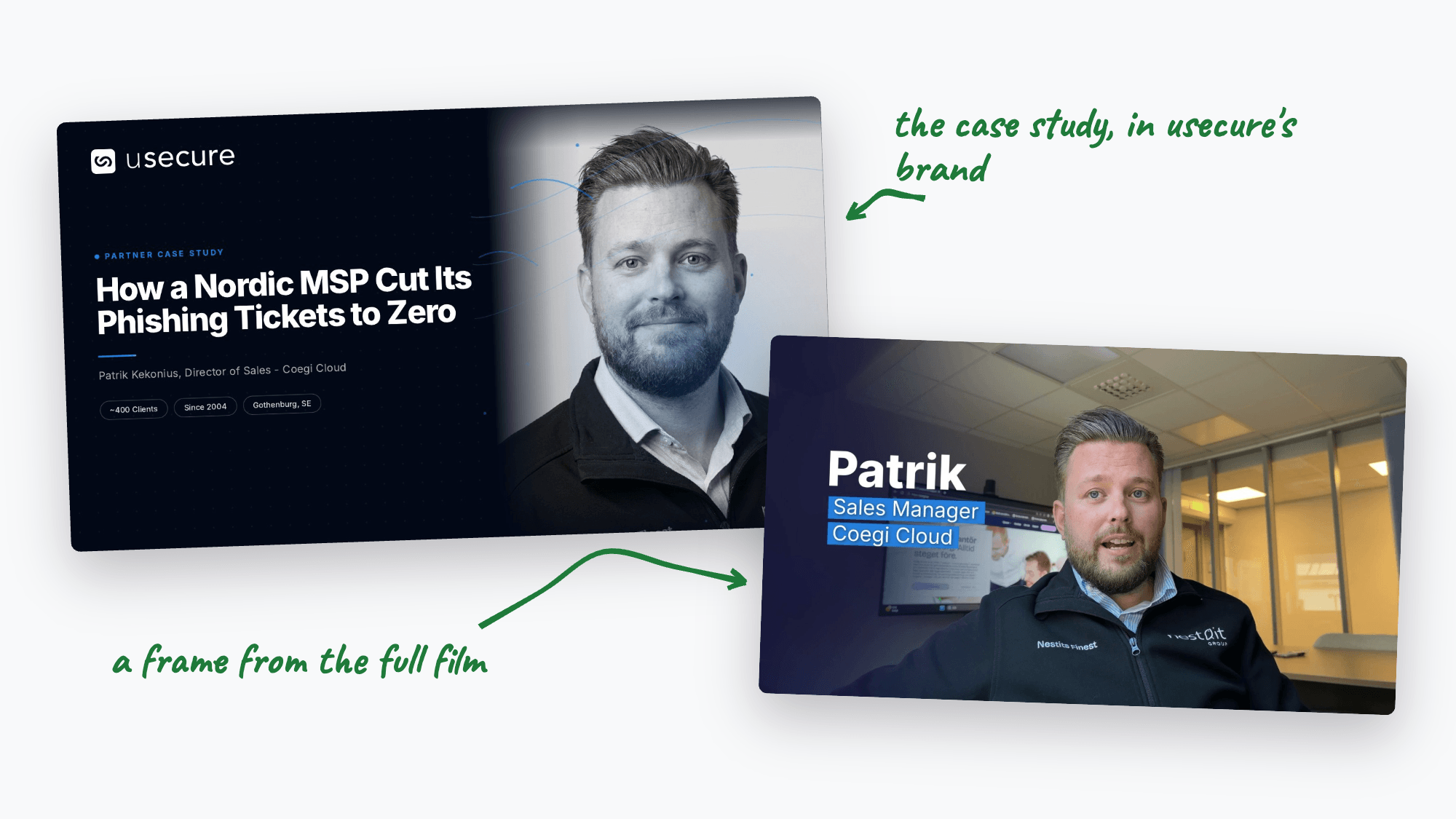
Patrik Kekonius, a sales manager at Coegi Cloud in Sweden, talked to me about the security awareness platform usecure, which his MSP resells. The line that does the most work for a sceptical MSP isn't about a feature:
And comparing the two different customer types, the ones using usecure and the ones not using usecure, we don't have any tickets from the ones using usecure.
How hard it is to take on. The second fear, after "will it work", is "how much of my team's time will this eat". A partner who can speak to onboarding answers it better than any implementation guide.
remember I'm working as a sales manager, I'm not that technical, but you know, even I can deploy a new customer
Whether it sells. For a product an MSP resells, the question is whether clients will pay for it and whether it helps the MSP win or keep business. If a partner tells you it gets them meetings or goes into every package, that belongs in the story.
How committed they are. The partner who says your product is in every tier of their offering is telling another MSP something no spec sheet can.
Sell through or sell to: does it change the story?
Yes, a lot. If MSPs resell your product to their clients, the story is about partners, margin and whether it sells, and it needs the channel team's language. If MSPs buy and use your product to run their own business or their clients' environments, like an RMM, a PSA or a quoting tool, the story is about engineer time, onboarding, the tool fitting how they work, and what their customers noticed.
Mixing the two is a common mistake. A story about margin is wasted on an MSP evaluating a tool they'd never resell, and vice versa.
Where do vendors use partner stories?
Partner recruitment. Your "become a partner" page, recruitment emails, event stands and the first conversation a channel manager has with a prospective partner. This is where a named peer describing the business case does the most.
Onboarding new partners. A new partner who can watch someone like them get up and running feels far less alone in the first ninety days, which is when partners quietly stall.
Enablement for existing partners. Give partners something they can use with their own clients: a story told from the end client's side, or co-branded material they can forward. Remember, they sell you when you're not there.
Your channel team's week. The objection a channel manager hears most often, answered by a partner on film, is worth having ready as a short clip with two lines of email to go with it.
Search and AI answers. Vendor buyers research with AI tools more than most. G2's 2026 research found 51% of B2B software buyers now start their research with an AI chatbot more often than with Google. A partner story published as a proper web page, with names and specifics in the text, is the kind of page those tools can read.
Should you interview the MSP or the MSP's client?
Both, for different jobs. The MSP is your proof for recruitment and for the partner's business case: why they chose you, what it did for their business, what it was like to take on. The MSP's client is your proof for partners to sell with: what the end customer noticed, in a story an MSP can forward to its own prospects.
If you can only do one, start with the MSP, because recruitment and retention of partners is usually where the channel team feels the pain first.
How many partner stories does a vendor need?
Enough to cover the partners you're trying to recruit. A single story from a large, sophisticated MSP doesn't reassure a ten-person shop, and vice versa. Aim for a spread across partner size and region first, then across the use cases or products you most want partners to adopt.
One interview a month, done properly, adds up to a library a channel team can actually search by partner type, rather than three polished stories that don't look like anyone in the pipeline.
When isn't a produced partner story worth it?
If you have very few partners willing to go on record yet, do the few you have well rather than chasing volume. And if your partners mainly need technical training rather than reassurance, a partner story won't fix that. It works when the thing holding partners back is doubt, and doubt is what only a peer can answer.
Questions people ask
What is an MSP partner case study?
A customer story told by an MSP about working with a vendor, used by that vendor to recruit and enable other MSPs. The best ones focus on the MSP's business outcomes and what it was like to take the product on.
Can partners use the testimonial content in their own marketing?
Yes, and they should be encouraged to. In our packs the MSP being interviewed also gets a LinkedIn post in their own voice and a short piece for their own website, which gives them a reason to share it.
What should a vendor ask an MSP in a testimonial interview?
What they were doing before, why they chose you when they did, what onboarding took, what changed for their business and their clients, whether it helps them sell, and what they'd tell another MSP weighing it up.
Should a channel vendor put partner case studies behind a login?
Keep the public version public. Partner portals are a good home for co-branded and enablement material, but a public story is what prospective partners, search engines and AI tools can find.
Related reading
- How sales teams use a testimonial every week
- Testimonial interview questions for MSPs
- Do testimonials help you get found in AI search?
Fifteen years inside the channel means your partners don't have to explain the MSP world to their interviewer. Every story ships with material for your channel team and for the partner.
See the pricingJames interviews MSP and tech vendor customers for a living and runs MSP Testimonials, the interview-led testimonial service. If a customer of yours has a story worth telling, this is how it gets told.