How sales teams use a testimonial every week
Marketing uses a story once. A seller should use it every week. Here's how, matched to where each deal actually is
 6 min read
Sales teams get the most from a testimonial by matching it to the stage of each deal. With a cold prospect, mention the named customer in one sentence and send nothing. Once they reply, send the film or case study. On a stalled deal, send the short clip that answers their objection. In a proposal, use a quote from the same sector, and with existing customers, open account reviews with a story.
Marketing uses a story once. It gets a launch post, a newsletter mention and a page on the website, and then marketing moves on to the next thing, which is completely reasonable, because that's marketing's job.
A salesperson should use the same story every week. It's at its most powerful in a live deal, when a prospect has just said the exact thing a customer on film has already answered. And yet the story that could have closed that deal is sitting in a Google Drive folder the salesperson has never opened. Here's how to change that.
Match the proof to the temperature of the deal
The most common mistake is sending the best asset too early. A film attached to a first cold email is a link from a stranger, and it gets treated like one. The same film sent to someone who has replied and asked a question is welcome.
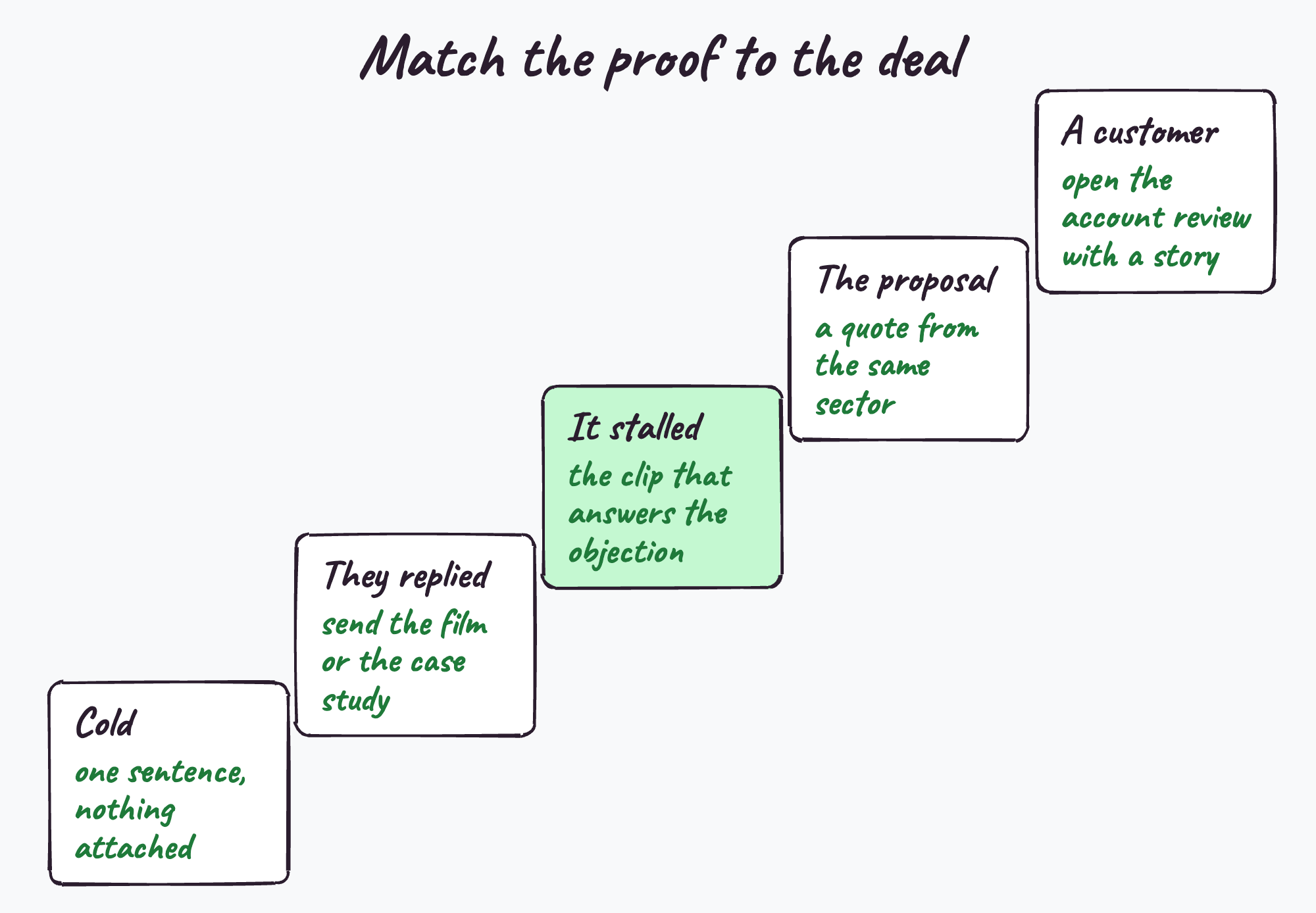
Cold prospects: one sentence, nothing attached
With someone who doesn't know you, proof is a sentence, not a file. Name a comparable customer and one specific detail, and ask whether it's relevant. Don't attach anything, don't link anything and don't lead with their problem.
Something like: "We recently helped the CEO of a small charity that was still running on an office server about ten years old, who told us 'every day I lived in fear that that was the day that the server was going to break'. Is that a situation you recognise?"
The film is the reward for replying. Sending it now spends your best asset on someone who hasn't yet decided to listen.
Once they reply: send the story
Now the case study and the film go. Choose by who you're talking to: the film for the person who needs to feel confident, the case study or one-page sales guide for the person who needs the detail or has to convince someone else.
Send one thing, with a line on why you picked it for them. "Given you mentioned the office move next year, this is worth two minutes" does more than "please find attached our latest case study".
Stalled deals: send the objection buster
Every deal that stalls has an objection behind it, whether or not the prospect has said it out loud. "We already have someone who handles our IT." "Moving will upset the team." "It's not worth the disruption right now."
This is exactly what the objection buster short in our packs is for: a clip of 45 to 60 seconds of a customer answering the objection that stalls deals most. Cheryl Kearney, the CEO of Sycamore Trust, answers the fear of staff pushing back on a move in her story for Urban Network:
I actually was really worried about the transition over from our current provider, moving over to Urban, all the new equipment, the phones. I think the whole staff team was so pleasantly surprised that it was really, really smooth.
Sent with one line, "you mentioned the team might resist, here's someone who worried about the same thing", that clip does something no salesperson can do on their own, which is answer the worry in someone else's voice.
Proposals: match by sector
In a proposal, pick the quote by the prospect's industry rather than by the service you're proposing. A law firm reading a proposal wants to see another law firm. Put a short quote with a name, role and company near the price, where the doubt is highest, and link the full story.
Existing customers: open the account review with a story
Quarterly reviews and renewals are where testimonials get forgotten completely. A short story from a similar customer who added a service is one of the most natural ways to open a conversation about what else you could be doing. That's why we tag each service short by whether the customer bought that service when they joined or added it later: the second kind is made for this meeting.
A week of using one story
It doesn't need a programme. It needs a habit, and here's what one looks like in practice.
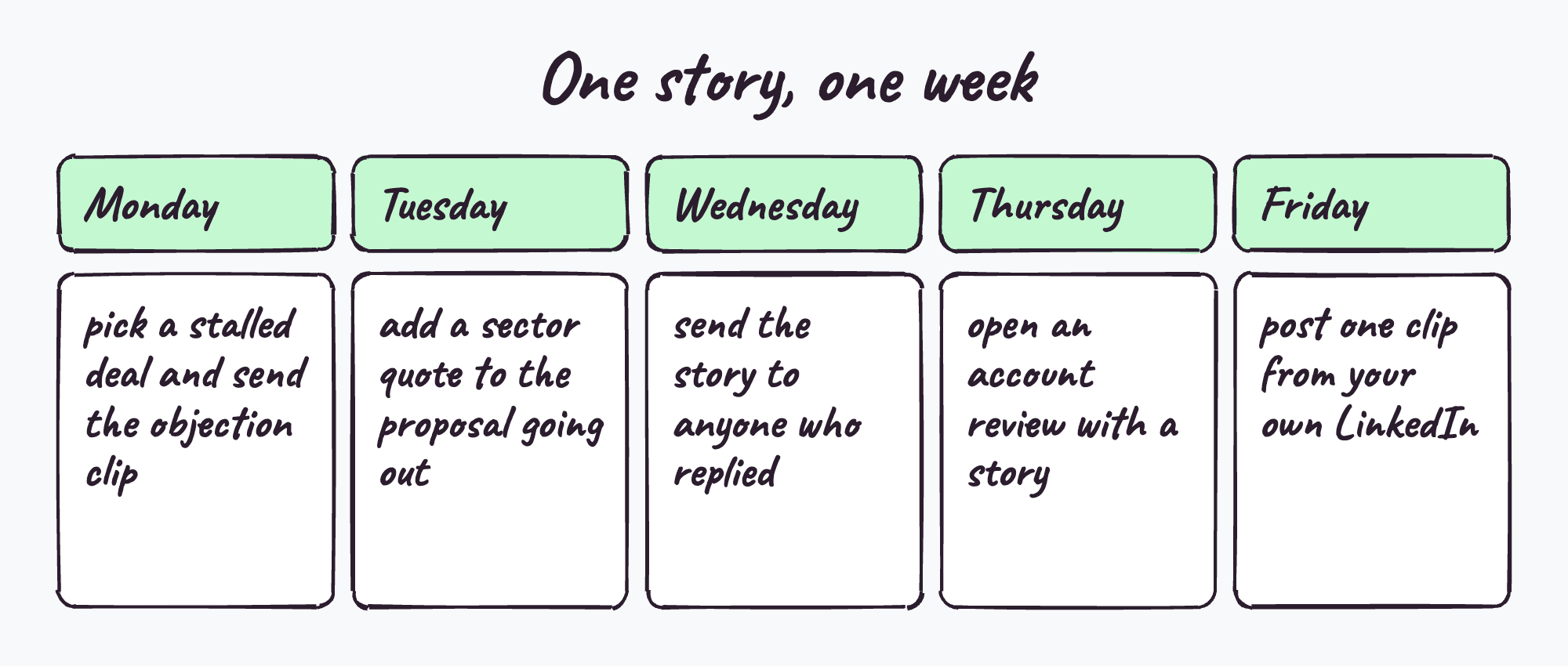
- Monday pipeline review: pick one stalled deal and send the objection clip.
- Tuesday: add a sector-matched quote to any proposal going out.
- Wednesday follow-ups: send the story to anyone who replied last week.
- Thursday account reviews: open one with a relevant story from a similar customer.
- Friday: post one clip or quote from your own LinkedIn profile.
What does a salesperson actually need?
Not the whole pack. A salesperson needs to know which clip answers which objection, the best quotes sorted by when to use them, and a few lines they can paste into an email. That's what the sales battlecard in every pack we make is for, and it's why it leads the pack rather than the film.
The other thing they need is to find it in ten seconds. If the story lives in a folder three clicks deep, it won't get used on a call. Put the battlecard and the objection clip wherever your team already works, whether that's the CRM, a pinned channel or the proposal template.
How do you know it's working?
Keep it simple. Add a field to your CRM for "story sent" and note which one. After a quarter, look at the deals that closed and the ones that stalled, and see whether the story was used. It isn't a controlled experiment, but it tells you quickly whether your team is using what you've paid for, which is the first thing to fix.
When shouldn't sales use a testimonial?
When the prospect hasn't engaged yet, as above. And when the story doesn't fit: sending a manufacturer's story to a law firm because it's the only film you have tells them you don't have any law firms. In that case, a relevant sentence about a similar client is better than an irrelevant film.
Questions people ask
Should salespeople put testimonials in cold emails?
Mention a named, comparable customer in one sentence, but don't attach or link the testimonial. Save the film and case study for when the prospect replies.
What is a sales battlecard?
A short internal document that gives salespeople what they need from a customer story in a live deal: the story in thirty seconds, the objections it answers, the best verbatim quotes sorted by when to use them, and email lines they can paste.
What is an objection buster video?
A short clip, usually under a minute, of a customer answering a specific worry that stalls deals, such as fear of disruption or staff resistance, for a salesperson to send when a deal goes quiet.
How often should a sales team use a customer story?
Every week, in the deals where it fits. A single well-matched story can be used repeatedly across proposals, follow-ups, stalled deals and account reviews.
Related reading
- Why most MSP testimonials don't work
- What you get from one testimonial interview
- How channel vendors use MSP partner stories
Every pack leads with a sales battlecard and an objection clip, so your team has something to send in a deal this week as well as something to post.
See how it worksJames interviews MSP and tech vendor customers for a living and runs MSP Testimonials, the interview-led testimonial service. If a customer of yours has a story worth telling, this is how it gets told.